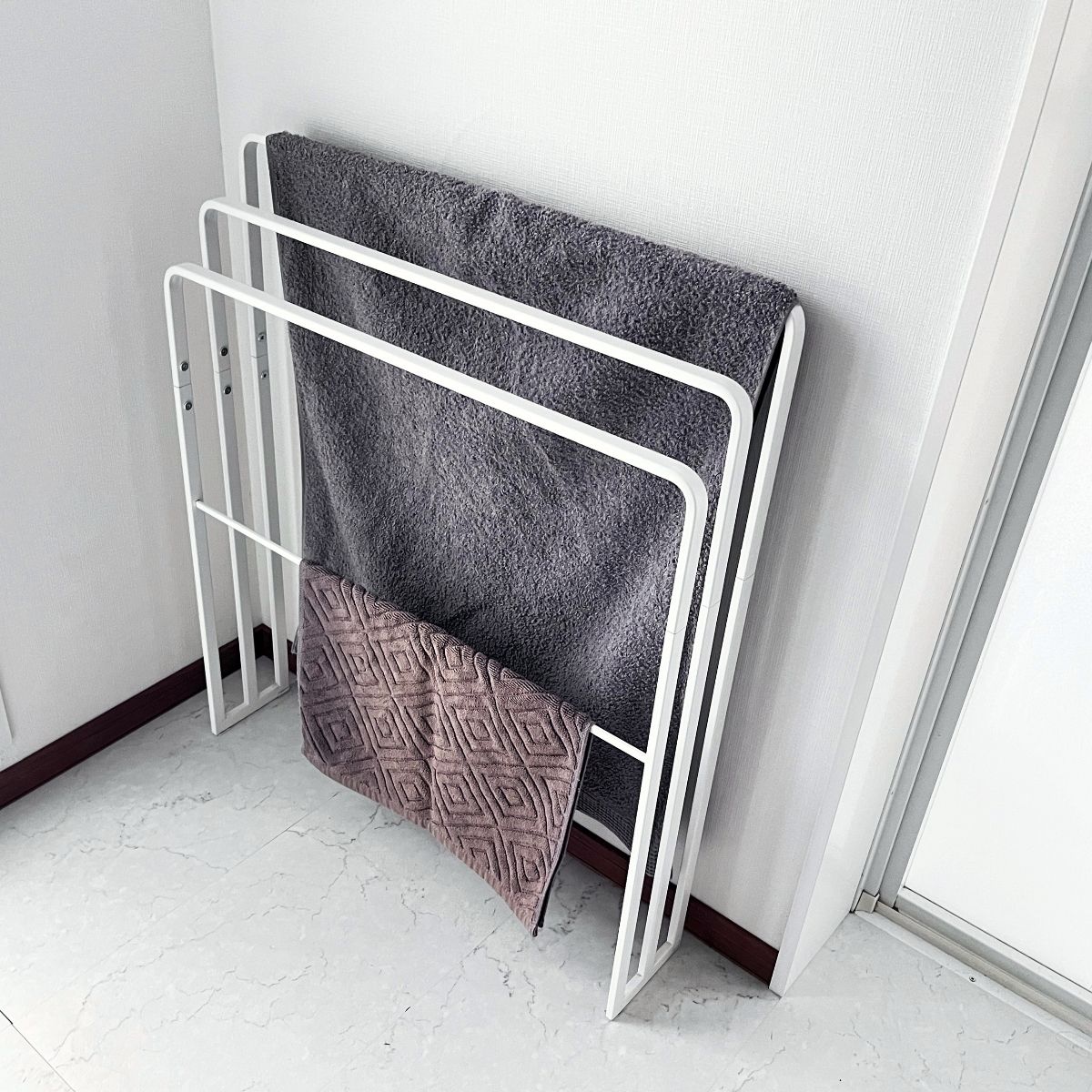
There is a towel stand on the floor of our washroom, just outside the bath. Four bars, 70cm (27.5in) wide, standing free — not fixed to anything.
In a lot of Japanese homes the bath is its own room — a waterproof space, with a drain in the floor — and the sink and the washing machine sit in a separate room just outside it. I’ll call that outer room the washroom, and the bath itself the bathing room. The stand lives in the washroom.
On it, most days: two bath towels and a bath mat — there are two of us, and the stand takes one more towel than we need. Sometimes a hand-washed shirt that is still damp.
It is not there to dry things, exactly. It is there because towels that have been used once are not ready for the laundry basket and not ready to be put away, and they have to be somewhere in between. With one towel bar and no wall you are allowed to drill into, that somewhere can be hard to find.
This is what we use, why we ended up with a freestanding one rather than something fixed, and the two things about it that the product page does not tell you.
- The problem is storage, not drying
- Why adding a bar to the wall is often not an option
- Two families of solutions, and how to pick
- Why we ended up with a freestanding one
- What it is actually like to use
- Two things the product page does not tell you
- Who this is not for
- What to buy, and where
- The short version
The problem is storage, not drying
Two people, one bath towel each per day. Laundry does not necessarily run every day.
So at any given moment there are used towels in the house that are going into the wash — just not yet. A damp towel can’t go into the laundry basket, because it will dampen everything else in there, and it can’t go into the machine either. It has to wait somewhere until it is dry enough to join the pile, or until the machine actually runs.
The obvious place — inside the washing machine, ready for the next load — is the one place they should not go. Ours is a front-loading drum machine, and damp fabric sitting in a closed drum is how you end up with a musty machine. Front-loaders have a reputation for this, and it is earned. Anything damp waits outside the machine until it is actually being washed.
That is the whole problem, and it is worth naming clearly because it changes what you should buy. If you are drying laundry, you want airflow and space between items. If you are parking used towels for a day, you want somewhere they can sit without touching the floor, without smelling, and without being in the way. Those are different requirements, and the second one is probably the more common household problem.
Why adding a bar to the wall is often not an option
Most rental housing in Japan comes with whatever towel bars the builder installed, and that tends to be the number you keep. Drilling into walls is generally not something tenants do — you are expected to return the place as you found it, and holes are the kind of thing that gets deducted from a deposit. I have written about that constraint at more length in the closet storage post; renters anywhere will recognise it.
What differs is how much has been built around it. There is a whole product category here for adding hanging space without fixing anything permanently — tension rods braced between two walls, magnetic racks that stick to a washing machine or a steel bathing-room panel, hooks and racks that hang over a door, and stands that just sit on the floor. Several competing answers to the same problem, sold side by side, and choosing between them is a normal part of setting up these rooms here.
Two families of solutions, and how to pick
Everything in that category falls into one of two groups, and the right one depends on what your bathroom has spare.
Use a surface you already have. Tension rods, magnetic racks, over-door hooks. These add hanging space without taking floor space, by borrowing a wall, a door, or the side of an appliance. This is the group to look at when the floor is full.
Put something on the floor. A freestanding stand depends on nothing — no wall, no door, no magnetic surface — but it occupies floor area that you then cannot use for anything else.
The choice is not about which is better. It is about which kind of space you have spare. A bathroom with 20cm (8in) of unused floor along a wall can take a stand. A bathroom where the floor is entirely taken has to go up the walls or over the door.
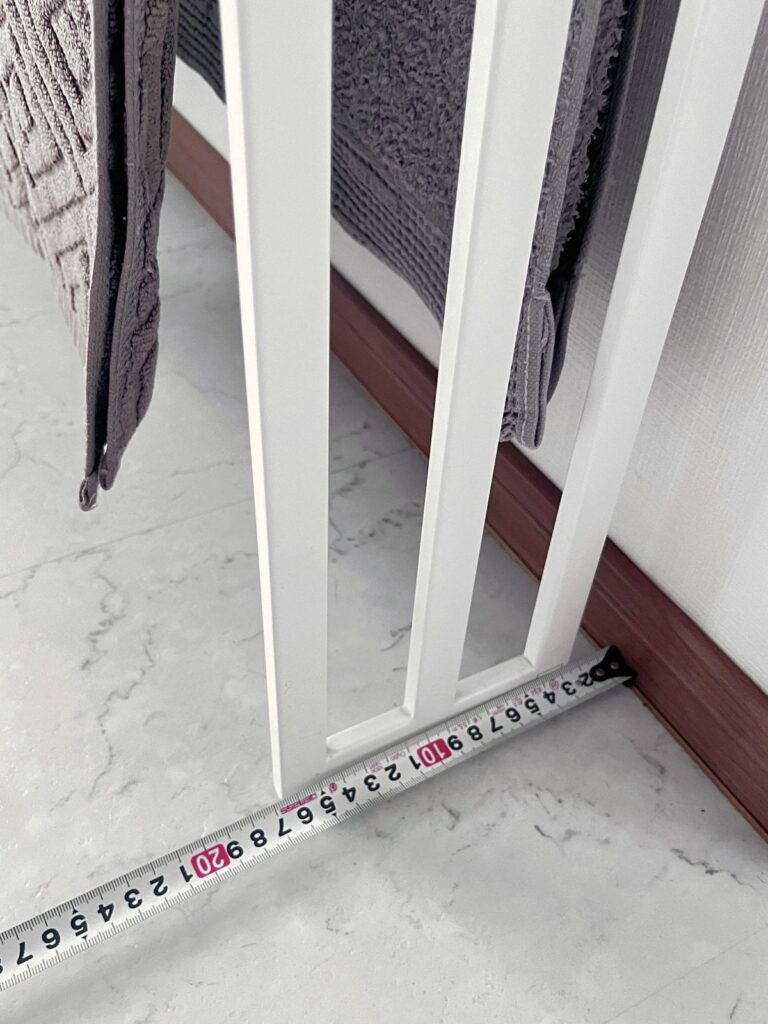
The box says 14cm (5.5in) deep, and that is true of the frame. But pushed flat against the wall, the back bar has no gap to hang a towel through. Leaving about 2cm (1in) of clearance puts the real footprint closer to 16–17cm (6.5in). Measure for that, not for the number on the box.
One thing worth checking before you commit to the magnetic option: not every washing machine takes a magnet. Ours has a resin front panel, and magnets simply fall off it. The wall of the bathing room next door does take them, so that’s where we use magnetic storage. If you are planning around a magnetic rack, test with a fridge magnet first — it is a two-second check that saves a return.
Why we ended up with a freestanding one
Two reasons, and I will give the less flattering one first.
There was room. The washroom in this flat is larger than the ones we have had before. A stand takes floor space, and this time we had floor space to give it. In a smaller place we would have been looking at the tension-rod and over-door options instead, not because those are worse but because they are what fits.
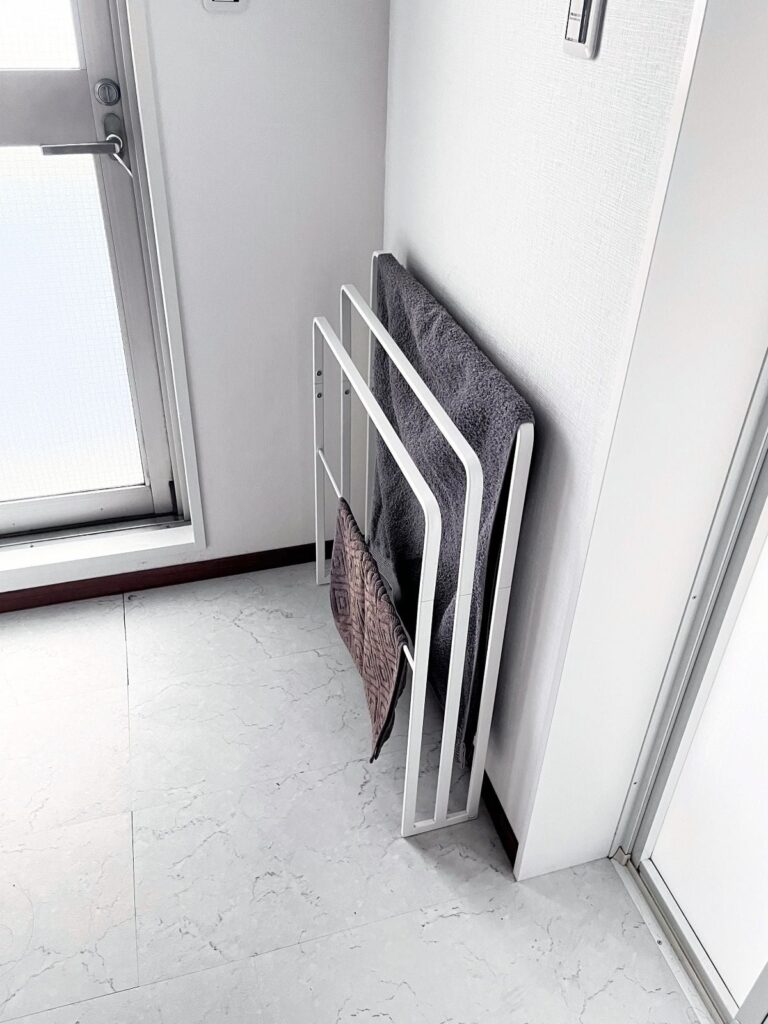
And I wanted something I did not mind looking at. The washroom is a room you pass through several times a day, and whatever is holding yesterday’s towels is going to be visible in it. Tension rods and over-door hooks are efficient, and they look like solutions to a problem. A stand can look like furniture. That mattered to me, and I would rather say so than pretend the choice was purely practical.
What it is actually like to use
The specifics, since these are the parts that are hard to judge from a listing.
The dimensions. 70cm (27.5in) wide, 81cm (32in) tall, and only 14cm (5.5in) deep — it is a thin thing. The lowest bar, the one the bath mat goes on, sits 38.5cm (15in) off the floor. The frame is narrow enough to sit almost flat against a wall, which is most of why it fits where it does.
The four bars are at different heights. The top three — 81cm (32in), 75cm (29.5in) and 69cm (27in) — are spaced 4cm (1.5in) apart and each take a bath towel, and a fourth, much lower at 38.5cm, holds the bath mat. You hang from the side rather than dropping a towel over the top. In practice ours are used like this:
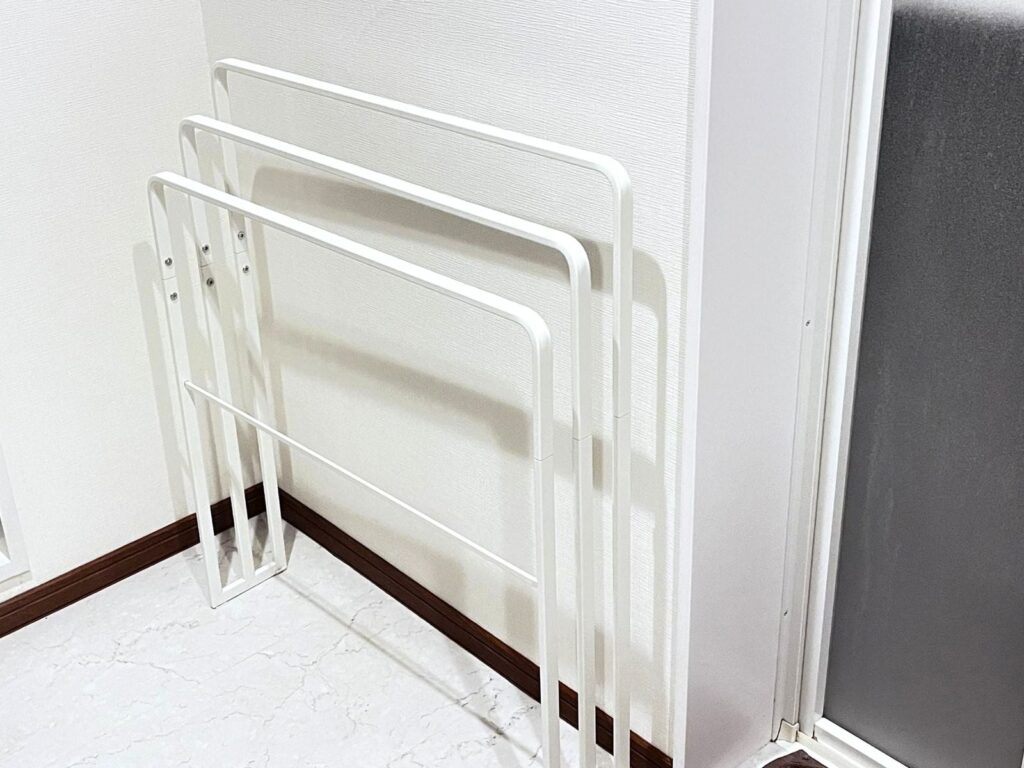
- Two of the top three bars: one bath towel each
- The third top bar: usually free — the stand has room for one more towel than we need
- Lowest bar (38.5cm): the bath mat
The bath mat goes on the lowest bar for two reasons. It is the heaviest thing on the stand, so having it low keeps the weight down. And it is the bar closest to you, so picking the mat up off the floor and hanging it is one motion.
It does not wobble. It is metal, and heavier in the hand than it looks. So far it has not felt close to going over, including with a wet mat on the front bar. This is the thing people ask about most with freestanding racks, so: no complaints.
Getting things off it is easy because of the side-hanging design. With bars only 4cm apart, a stand you had to lift towels over the top of would be awkward. Sliding them off sideways is not.
Two things the product page does not tell you
Both of these only show up once you own it.
The lowest of the three bars you hang bath towels on is 69cm (27in) off the floor. Our bath towels are 130 × 60cm (51 × 23.5in), a standard size here. Folded once over that bar, a towel hangs 65cm (25.5in), leaving 4cm (1.5in) of clearance. Hang it carelessly and the bottom edge touches, and the floor of a room you step out of the bath into is not always dry. It is a matter of taking a second to hang it neatly rather than a real fault, but it is the thing I would most want to know in advance.
If your towels are longer, do the arithmetic before you buy. Yamazaki give the stand’s limit as towels up to 147cm (58in) long and 62cm (24.5in) wide — but on the lowest bar, anything longer than about 138cm (54in) will reach the floor when folded once. A bath sheet at 170cm (67in) hangs 85cm (33.5in), longer than even the top bar is high, so you would be folding it twice.
That is worth knowing rather than worth giving up over, because the drop is a property of this particular stand, not of the problem. Yamazaki’s laundry range alone splits into nine categories, and hanging a towel is solved several ways across them: bars that mount under a cabinet, racks that hook over a cupboard door, hangers that clamp to the edge of a shelf, drying racks meant for laundry that will hold a bath towel perfectly well. Plenty of what works here isn’t filed under “towel hanger” at all — the category a maker files something under is a hint, not a limit.
Among those, the magnetic bars are the ones I would look at first for this particular problem. They stick to the side of a washing machine or a steel bathing-room panel, and because a magnet goes wherever you put it, you choose the height — which is the one thing a fixed stand can’t give you. There are three-bar versions. If your towels are long and your machine takes a magnet (test with a fridge magnet first), that should take care of the drop problem.
The towel bars only work if you use them as three. The stand is designed to be loaded from the side — you slide a towel on rather than dropping it over the top. Do that, and each of the three holds one towel and all of them stay usable. Drape a towel over the top instead and it falls across the whole stand, covering the bars below it.
This is the reason the side-loading design exists: with 4cm (1.5in) between bars, there is no room to hang over the top neatly. Whether everyone in your household loads it that way is a separate question, and not one the product can solve.
Who this is not for
Before the links, the honest list of people who should buy something else:
- If your bathroom floor is already full. A stand needs roughly 70 × 17cm (27.5 × 6.5in) of floor it can keep. Tension rods and over-door racks exist precisely for this case.
- If you use oversized bath sheets. See above — the lowest bar is likely to be a small, recurring annoyance.
- If you need to dry things properly, not park them. 4cm (1.5in) between bars is not much airflow. For actual laundry drying you want a proper airer with wide spacing.
- If four or more people are using it. There are three bars for bath towels, and the fourth person is hanging over someone else’s.
What to buy, and where
The stand we use is from Yamazaki Home, a Japanese manufacturer whose tower range covers a lot of this ground — freestanding stands, magnetic racks for washing machines, over-door hooks, tension-fit shelving. The same problem solved several ways, which is useful when you are working out which family of solution your bathroom needs.
They do not run their own stores. In Japan you tend to meet the products on someone else’s shelf and learn the brand name afterwards, and the same is true abroad: in the US they are carried by The Container Store, west elm, Wayfair, Crate & Barrel and Amazon, as well as their own site. Their bathroom stands and racks are among the items that made it into the international range, so this is one of the cases where you can buy the actual product rather than an approximation.
A note on ordering from Japan: the Japanese range is considerably wider than what is exported, so it is worth checking whether the variant you want is already available where you are before looking at a proxy service. A towel stand is also light but bulky, and international shipping is generally priced by volume — a 70cm (27.5in) metal frame is not a cheap thing to send. If what you want is sold locally, buy it locally.
The short version
- Used towels need a parking place, and that is a different requirement from drying.
- Damp things should not wait inside a front-loading machine.
- Pick by what space you have spare: surfaces for a full floor, a stand for a spare floor.
- Test with a fridge magnet before planning around a magnetic rack.
- The frame is 14cm (5.5in) deep, but leave about 2cm (1in) off the wall so the back bar stays usable.
- Put the heaviest item on the lowest bar.
- Load the bars from the side. A towel dropped over the top covers the whole stand.
- If your bath towels are long, measure them against the lowest bar: folded once, anything over about 138cm (54in) will touch the floor. A magnetic bar lets you set the height yourself.