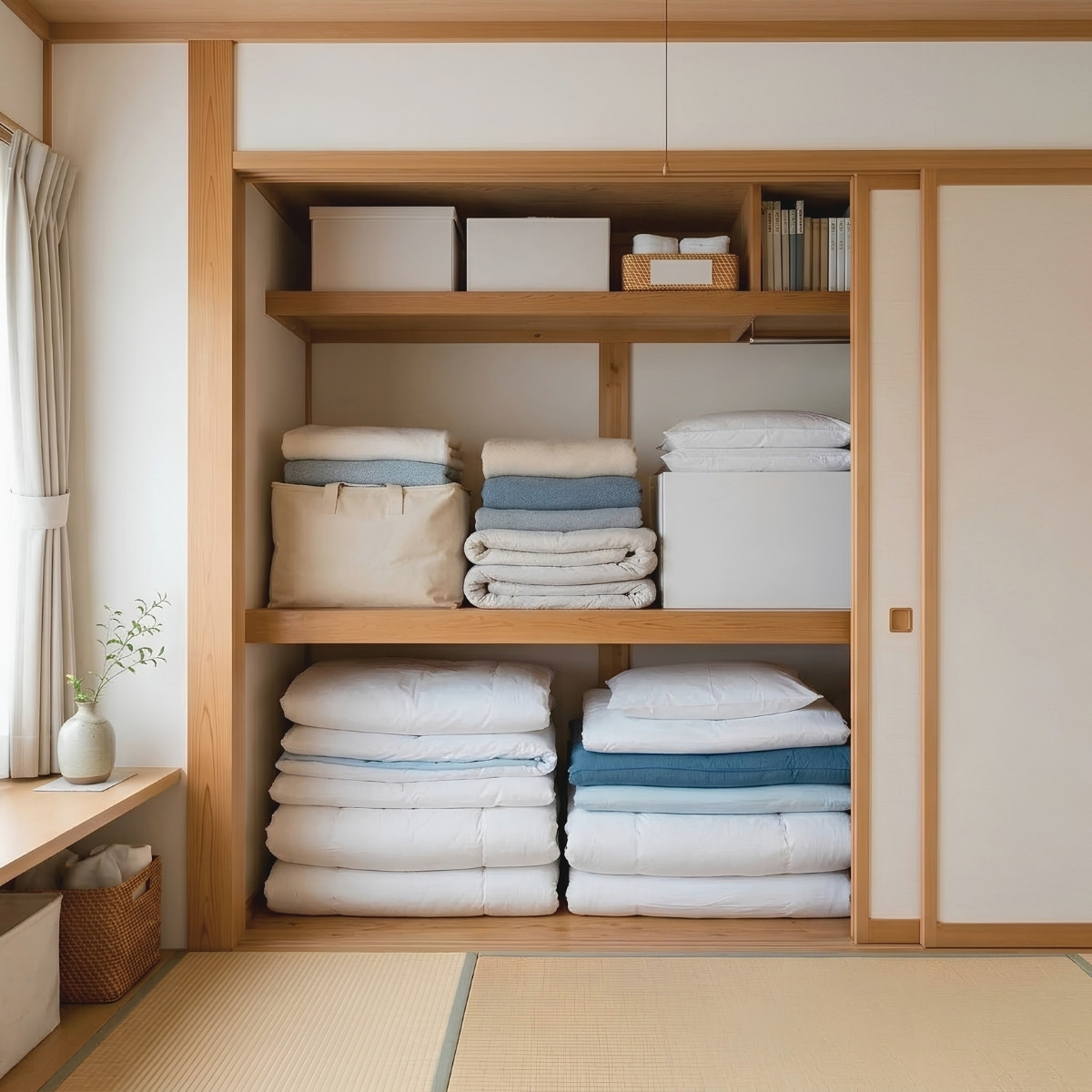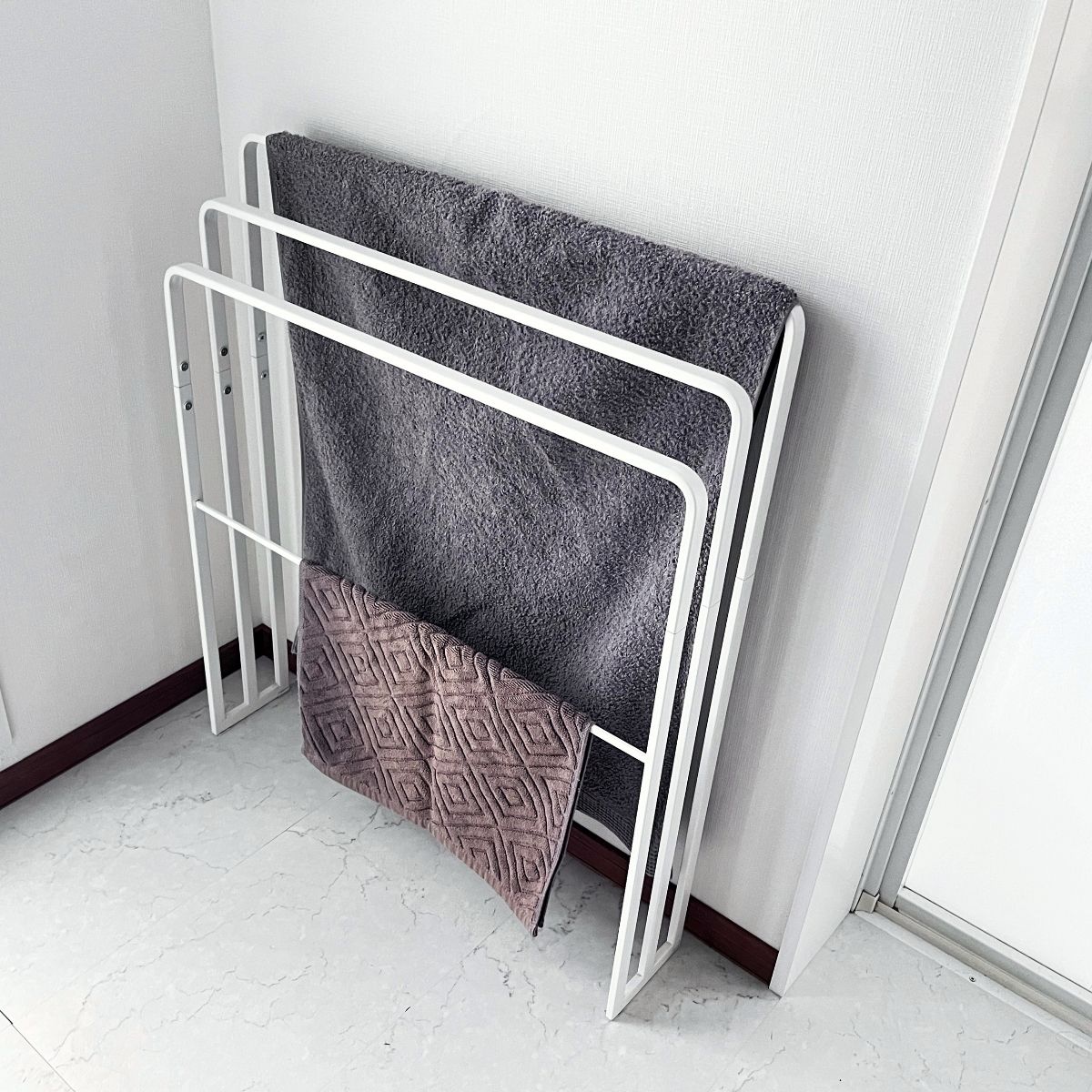
There’s a rule underneath a lot of Japanese storage design: you can’t put a hole in the wall. Rental contracts here carry an obligation to hand the place back the way it came, so anything that mounts by pressure, by hooking over an edge, or by sticking has an advantage over anything that needs a screw. I wrote about how that shapes closets and living spaces in the first half of this.
The bathroom and the kitchen are where it shows most. They’re also the rooms where a Japanese home differs most from a Western one — enough that some of the products only make sense once you know how the rooms are used.
The bath is a room, not a fixture
Soaking in the tub is an everyday thing here rather than an occasional one. Filling the bath and getting in at the end of the day is simply how the day ends for a lot of people, through the year, and nearly every home has a tub for it.
But you don’t wash in it. You wash first — sitting or standing on the floor outside the tub, soaping up and rinsing off completely — and only get in once you’re clean, to soak. Since nobody washes in the water, it stays clean enough for the next person, so a household goes through the same bath in turn. That’s why tubs here come with a lid to hold the heat and a button on the wall to warm the water back up.
All of which means the washing happens out in the open room rather than inside an enclosure — so the room is built for it. Floor, walls and ceiling are waterproof, and water going anywhere is expected rather than a problem.
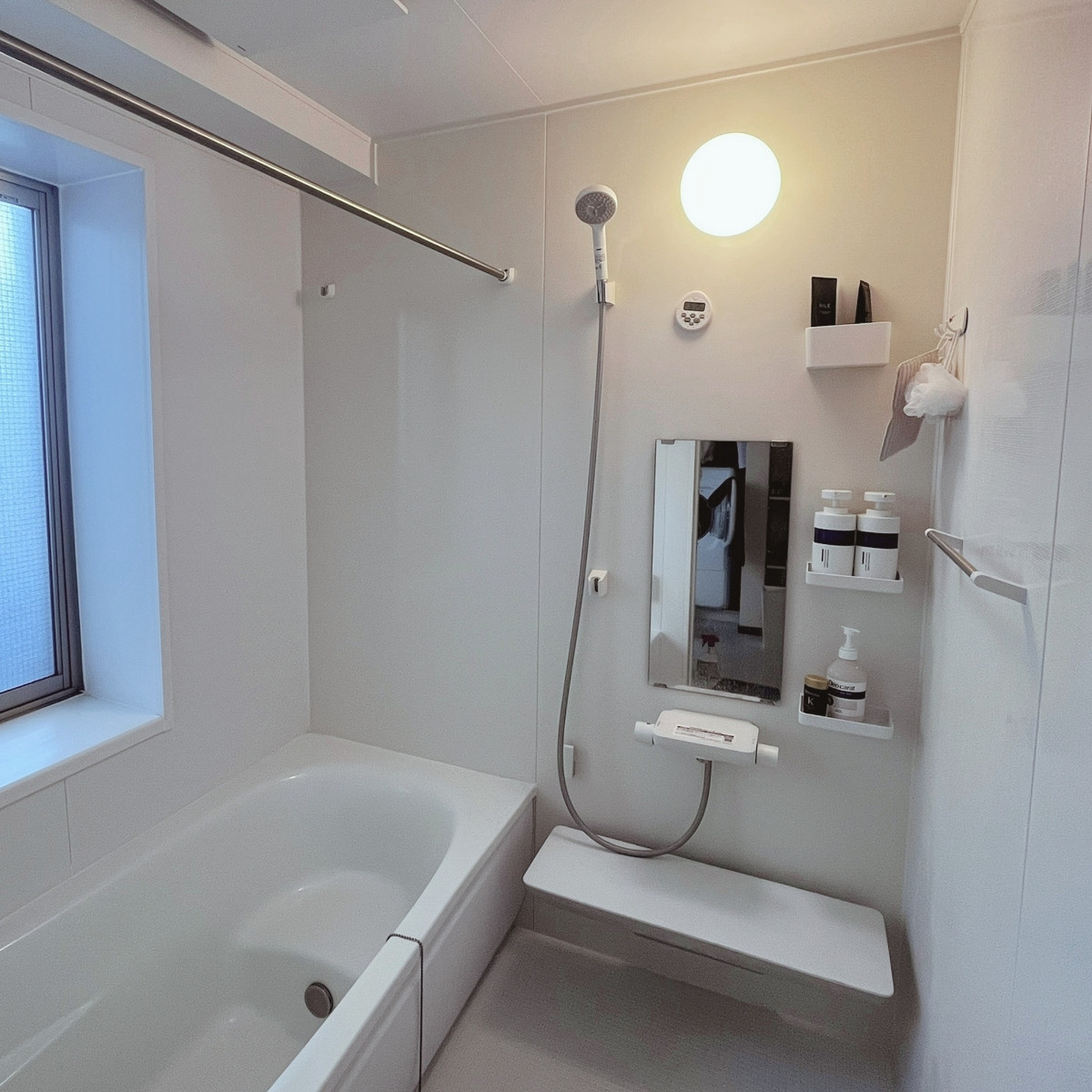
Once you see the room that way, the storage makes sense. Every shelf, hook, mirror and bottle holder has to survive being splashed daily and drying out between times, so there’s a deep catalogue made for exactly that — and a lot of it mounts without fixings, because of the rule at the top of this page.
The space above the washing machine
The laundry area is usually just outside the bathroom, and it has a shape that repeats in a lot of homes here: the machine sits in a shallow alcove with a metre or more of unused height above it. Catalogues have a section for it — 洗濯機上 (sentakuki-ue, “above the washing machine”).
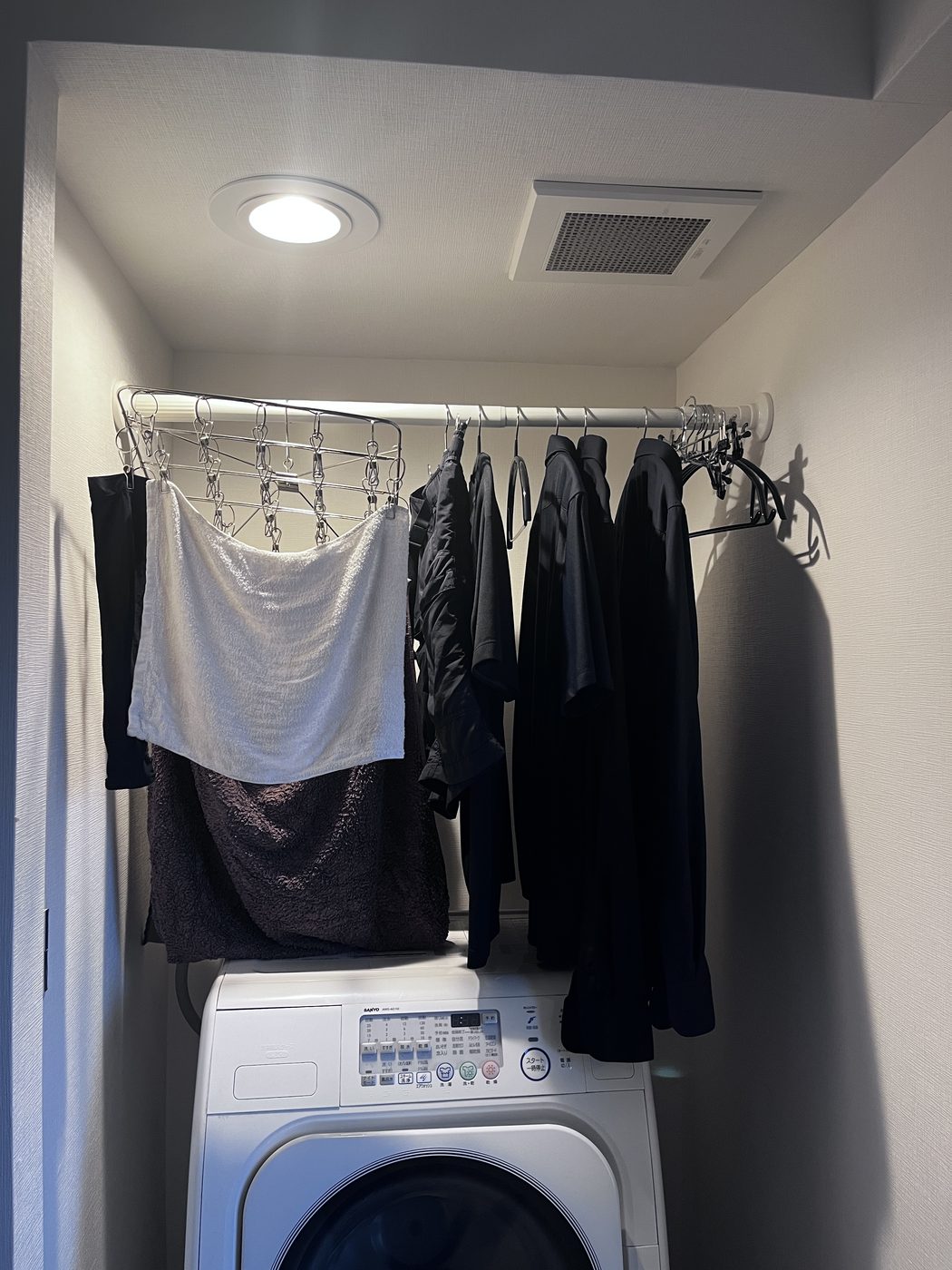
The rod itself is the archetype of no-damage mounting here. Tsuppari-bō are sold in dozens of lengths and load ratings, and a rod wedged between two surfaces becomes a drying rail, a shelf support, a second tier inside a closet, or a hanging store above an appliance.
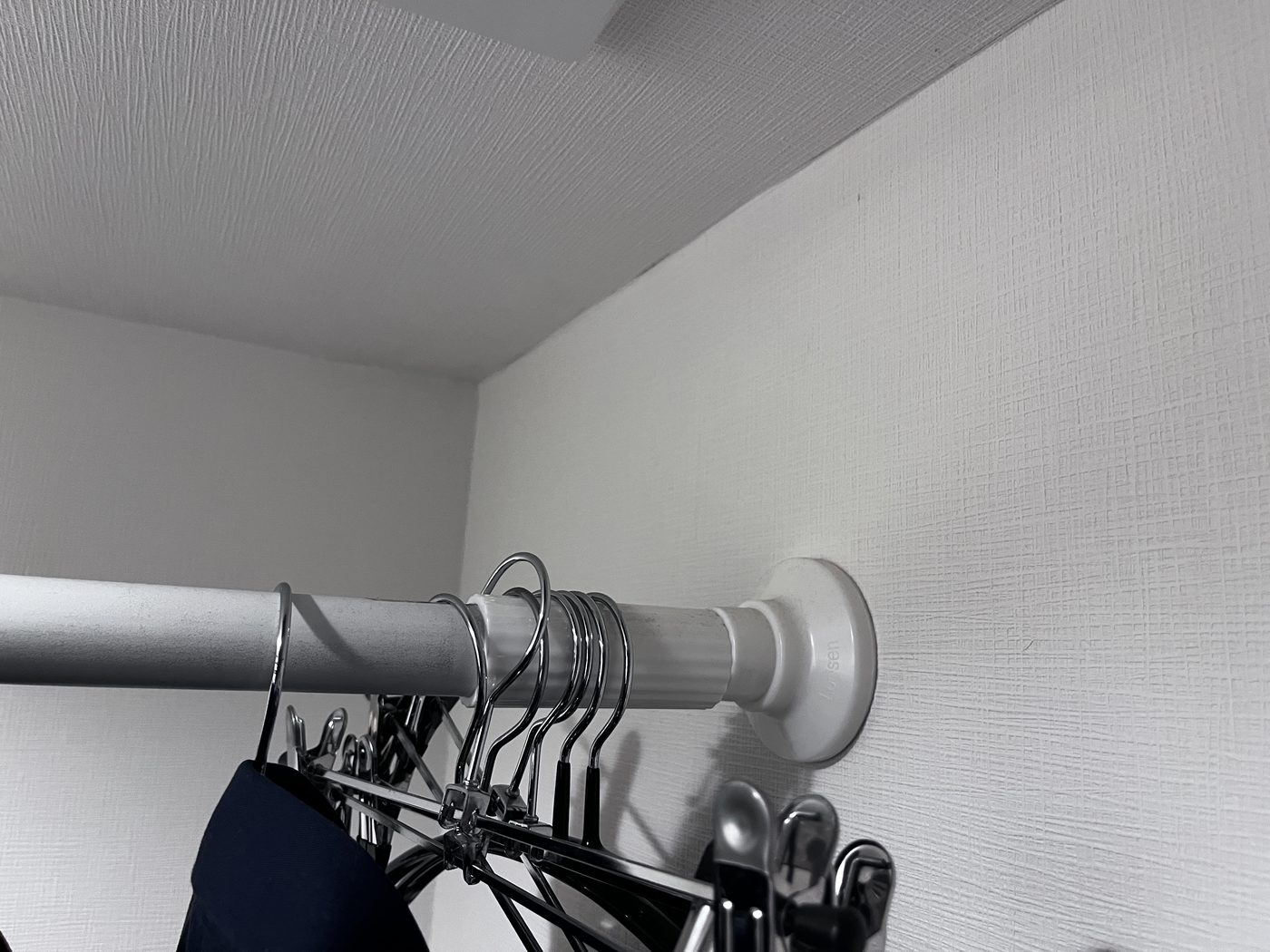
If your laundry area has the same shape, the idea moves across unchanged even when a specific product doesn’t. Measure the opening, check the load rating, and you’ve reclaimed a metre of wall that was doing nothing.
Magnetic storage, and why it caught on
The other thing you see a lot of in these two rooms is magnetic storage. The appeal has less to do with magnets being clever than with three fairly ordinary things:
- Anywhere on a surface that takes a magnet. No hunting for a stud, no bracket to line up with. If the panel holds, the rack goes where your hand reaches when you’re standing there — which is the part that decides whether you actually use it.
- It leaves no mark, so you can move it later. Wrong spot, or a new place to live? Lift it off. Nothing to patch, nothing to explain to a landlord.
- It takes no tools and no skill. You hold it up and let go. That’s the installation.
Which is the same appeal as the tension rod, arrived at from a different direction: storage you can add, move and undo freely.
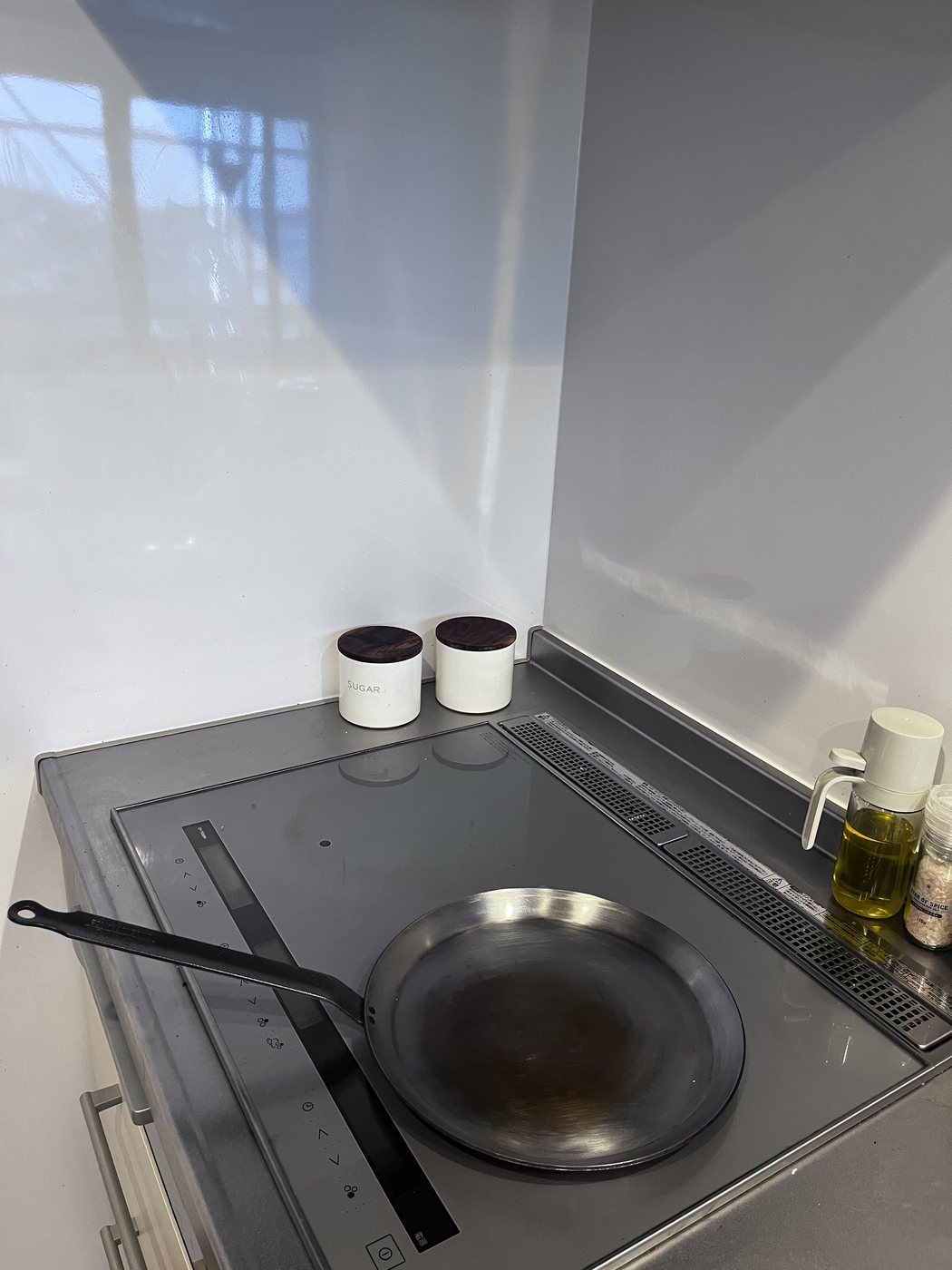
In the bathroom that means shampoo racks, mirrors, hooks and razor holders going straight onto the wall panel. In the kitchen it’s the panel behind the hob — a smooth sheet that takes splattered oil and wipes clean with a cloth, a common fitting here though it depends on the kitchen — plus the side and the front of the fridge.
The catch: two rooms, opposite answers
The surface has to be magnetic, and that is never a given — including here. Bathroom and kitchen panels are often built around an aluminium core, and there’s no way to tell by looking at them.
My own flat has one of each, which turned out to be a useful accident.
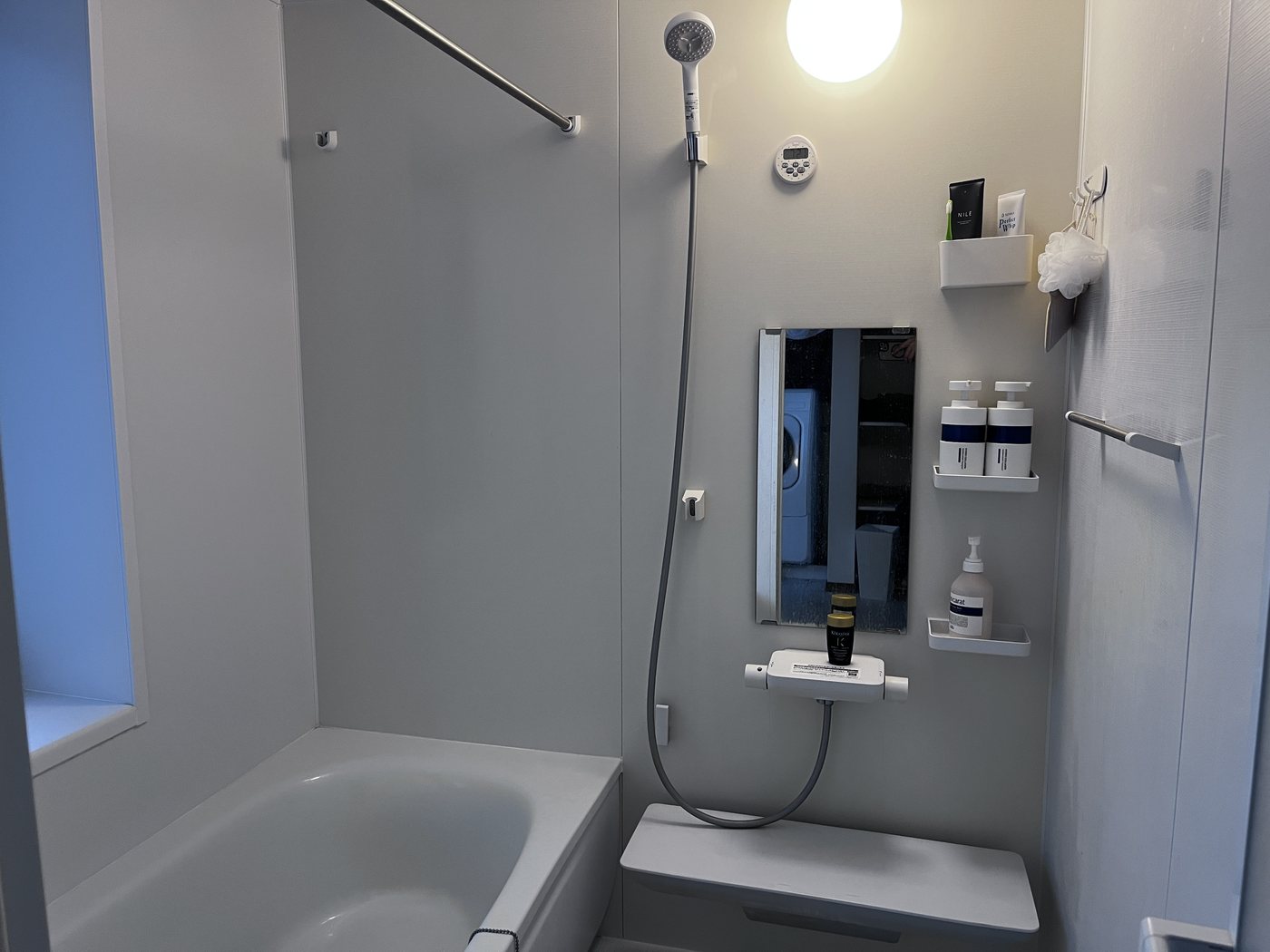
The bathroom wall takes a magnet, and I’ve leaned on that. The room came with a couple of moulded shelves and not much else, so nearly everything on the wall in the photo above is magnetic storage I added afterwards — shifted around a few times until each thing sat where I actually reach for it. That freedom to reposition is the part I’d miss most.
The panel behind my hob is the other kind. A magnet slides straight off it, so that whole category of kitchen racks is closed to me — in a Japanese kitchen, in Japan. Two rooms, one flat, opposite answers. Which is the point: the test matters far more than where the product was made.
In a previous flat the kitchen wall did take a magnet, and I kept the seasonings I reach for daily on a magnetic rack right beside the hob. It’s a small thing you stop noticing until it’s gone. Here it’s gone.
Outside Japan the odds are longer again: a tiled or acrylic bathroom won’t hold anything, and neither will a tiled backsplash. The fridge is usually the best bet, though plenty of stainless doors turn out to be non-magnetic in exactly the spot you had in mind.
So do the thing I should have done before buying: carry a fridge magnet around and press it to every surface you’re picturing. Judge it honestly, too — something that grips well enough to stay up empty can still let go once there’s a bottle of shampoo sitting on it.
If the wall says no, the wall is changeable
This turns out to be its own small category here, in two forms.
One is a thin sheet with iron powder running through it. The removable kind peels away cleanly and leaves the wall unmarked, which is the whole reason it works in a rented flat — the same logic as the tension rod, applied to the wall itself rather than to what hangs on it. Not every product is removable, though, so that’s the line to find on the packaging before you buy. Once it’s up, people usually cover the whole area seamlessly and then paper or tile over the top, so it reads as a finished wall rather than a fix.
The other is tile: small stainless-coated or iron-cored tiles laid edge to edge, which give you a magnetic surface and a decorative backsplash in one go. That’s the version having a moment here.
Neither is really Japan-specific — an iron-powder sheet works the same behind any hob, anywhere — and both are heavy, so shipping them across an ocean rarely makes sense. Worth knowing they exist, and worth buying close to home.
What transfers and what doesn’t
- Transfers well. Over-the-door and over-the-cabinet racks. Tension rods above a washing machine or across an alcove, wherever you have two parallel surfaces at the right span. The habit of looking at the metre of wall above an appliance as usable space.
- Transfers if you check first. Magnetic racks — test the exact panel with a fridge magnet, not the appliance in general. Tension rods, whose load ratings are given in kilograms.
- Usually doesn’t transfer. Anything that assumes a wet room. Bath lids and thermal covers sized to a Japanese tub. Products for surfaces your home doesn’t have.
- Buy locally instead. Iron-powder sheets and magnetic tiles. They work anywhere and weigh too much to import sensibly.
Where to start
Take a fridge magnet into your bathroom and kitchen and test every surface you’ve ever wished had a shelf on it. Then measure the gap above your washing machine. Between them, those two checks tell you which of the ideas here you can use and which you can skip — before you spend anything.
Some of these products can only be bought in Japan, so for those you’ll need a proxy service. I wrote a full walkthrough of how that works and what it costs here: How to Order From Japan.