This post contains affiliate links (see my disclosure for details). As an Amazon Associate I earn from qualifying purchases.
Takoyaki is a bite-sized, ball-shaped dish made by pouring a wheat-flour batter into round molds. In Japanese, tako means octopus and yaki means grilled or cooked, so the name is fairly literal: there’s a small piece of octopus inside each ball. Most people top them with takoyaki sauce and mayonnaise, and often bonito flakes and dried seaweed as well.
It started in Osaka in 1935 and spread from the Kansai region across the country. Today there are several takoyaki chain shops, and you’ll find them in shopping malls and train stations.
Takoyaki tastes best hot, straight off the pan. And the method is simple — pour the batter, drop in the filling, turn the balls over. So at home, the machine usually sits in the middle of the table and everyone cooks and talks while they eat. Nobody gets stuck alone in the kitchen, which I like.
Quite a few homes in Japan have a takoyaki maker. One survey put ownership in the Kansai region at around 70 percent. I couldn’t confirm a nationwide figure, but it isn’t an unusual thing to own.
When I lived alone, I bought a takoyaki maker at Don Quijote, a discount chain, for around 1,000 yen (about US$6.5, depending on the exchange rate). It was electric — you plug it into the wall.
The one I use now isn’t electric. I switched to a butane model, and I’ve been using it for close to ten years.
- What bothered me about the cheap electric one
- What changed with the butane one
- When we actually get it out
- What goes inside (it doesn’t have to be octopus)
- About the batter
- How I store it
- Why butane is an option in Japanese homes
- What the machine is
- When electric makes more sense
- What you can actually buy in the US
- The ingredients are available in the US
- Wrapping up
What bothered me about the cheap electric one
This is about the one machine I owned, not about electric takoyaki makers in general. A more expensive electric model may handle some of this differently.
It took a long time to cook. There was a long wait between pouring the batter and having something ready to eat.
The heat was weak, so it was hard to get a crisp outside and a soft center — the kind that almost runs when you bite into it. For me, that contrast is the whole point of eating takoyaki.
The plate stayed hot after I turned it off. If I left the finished balls sitting there, the bottoms kept cooking and started to scorch.
And washing it made me nervous. Mine had a plate that didn’t come off, so I couldn’t put the body under water. That meant wiping it down instead. Cleanup happens every single time, so this may have been the biggest one.
What changed with the butane one
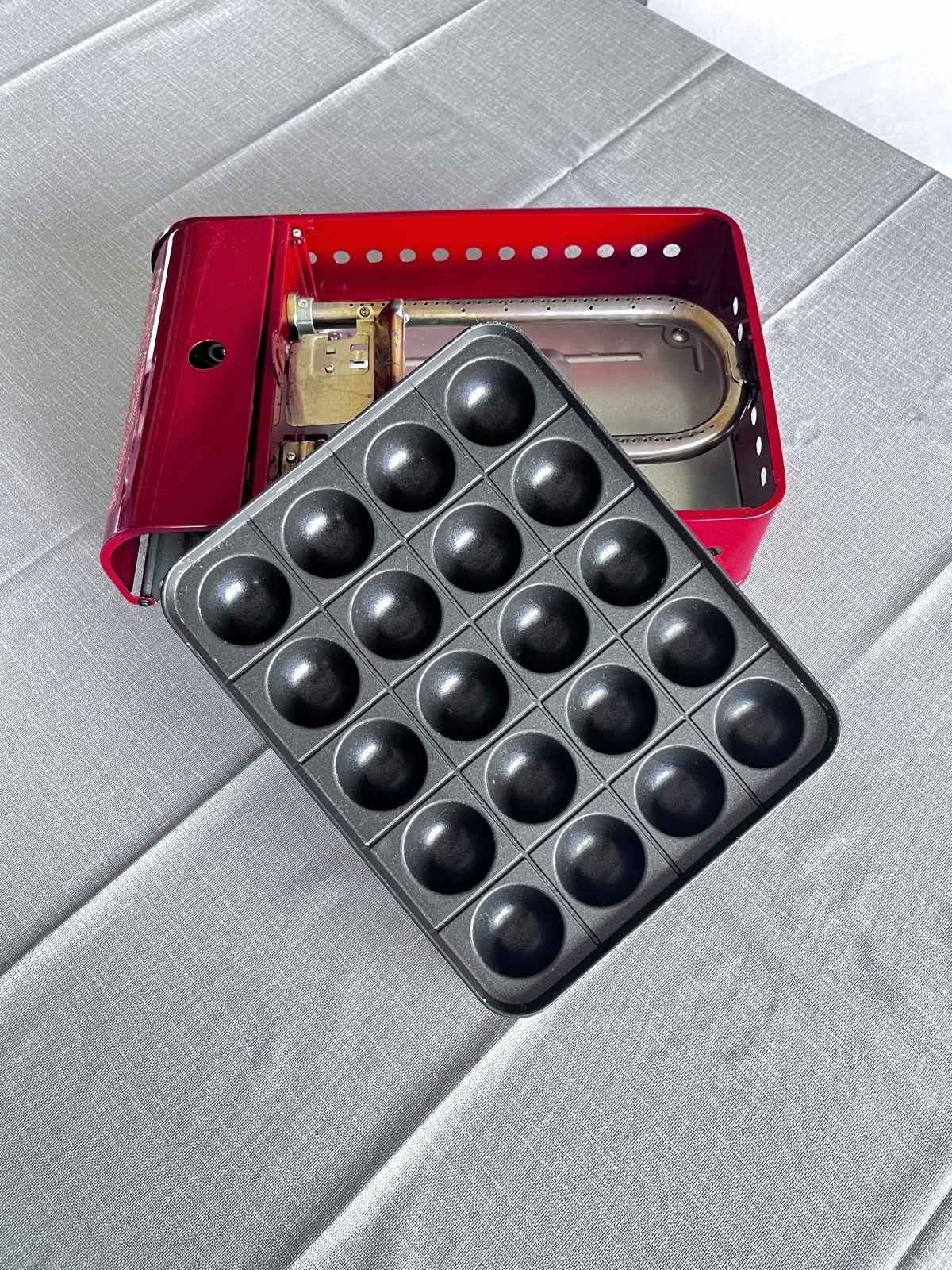
What I use now is an Iwatani butane takoyaki maker.
The heat is strong, so I get a crisp outside and a soft center. That’s the main reason I switched.
The flame is easy to adjust. Turning the dial changes it right away, so I can work by what I’m seeing in the pan.
I can turn the flame off when they’re done — or drop it to a low flame to keep them warm. This is the biggest difference from the electric one.
The plate lifts out and washes under the tap. I can clean it without worrying about the body, and cleanup got much easier.
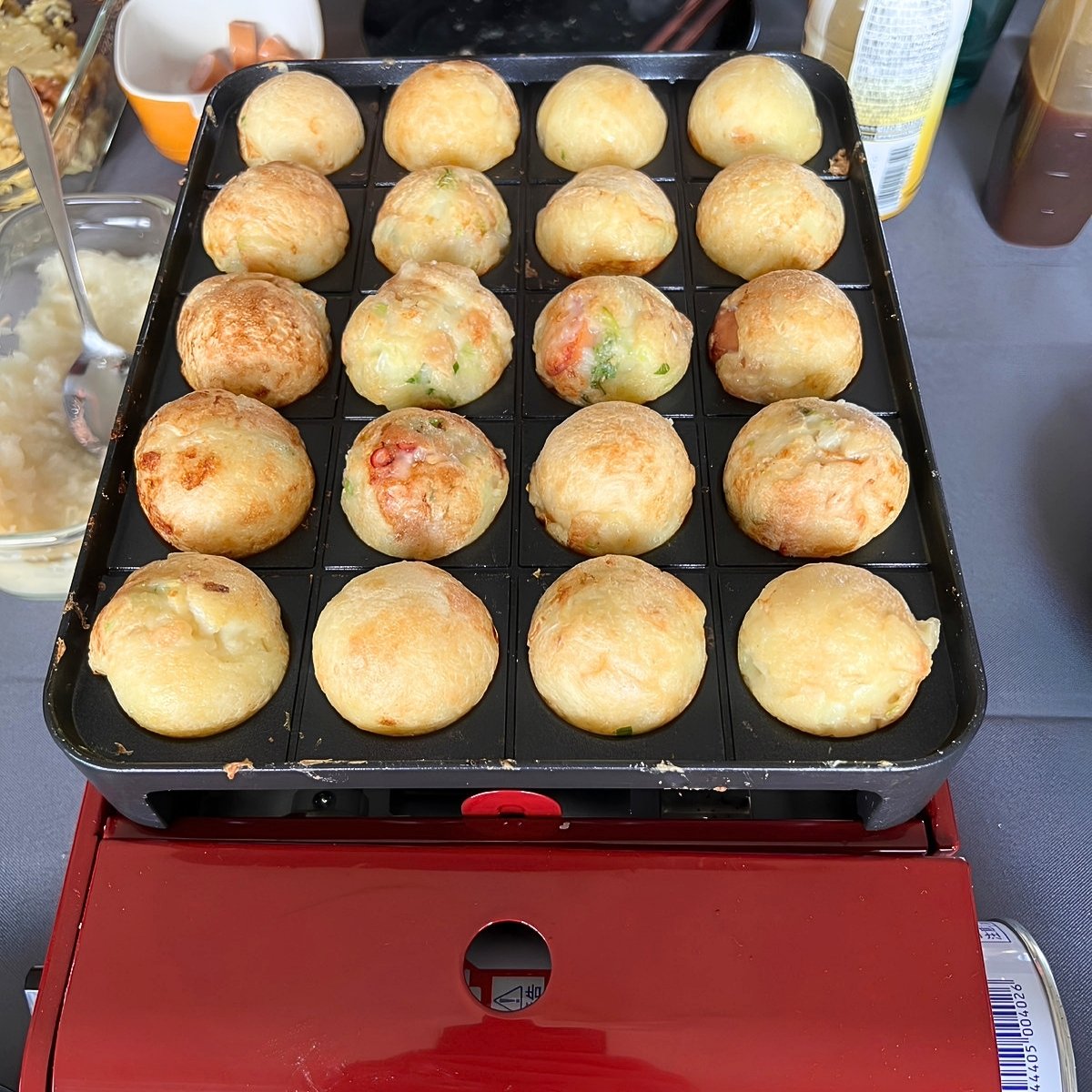
When we actually get it out
This isn’t a weekly tool. We use it a few times a year.
But it makes things easy when people come over. It goes in the middle of the table and we cook while we eat — something like a barbecue you can do indoors. The cook and the guests aren’t split into two groups, and I think that’s the best part.
What goes inside (it doesn’t have to be octopus)
The name says octopus, and that’s the standard. But we often fill ours with something else.
My husband will eat octopus, but he doesn’t choose it, so we fill some of them with other things.
Here’s what we actually use:
- Sausage, cut small
- Cheese
- Corn
- Bacon
- Imitation crab sticks (kanikama)
In US stores, kanikama is usually labeled imitation crab or crab sticks. It’s made from surimi, a fish paste.
These are all easy for children to eat, which helps when people come over with kids.
About the batter
Sometimes I use takoyaki flour, which is a pre-mixed flour made for this. Sometimes I mix my own. Either works.
When I mix my own, it’s flour, liquid shirodashi, egg, and water.
I use liquid shirodashi at home, but powdered dashi works too — you just dissolve it in the water. A small packet is also a lot easier to buy and store than a heavy bottle.
For sauce, Otafuku takoyaki sauce is the standard one, and it’s available in the US. The company has a production site in Los Angeles, and some of their sauces are made there.
How I store it
Since we only use it a few times a year, storage matters. If getting it out were a hassle, I think we’d stop using it.
At our place, one drawer under the sink holds all the tabletop cooking gear together — the takoyaki maker, the hot plate, the waffle maker.
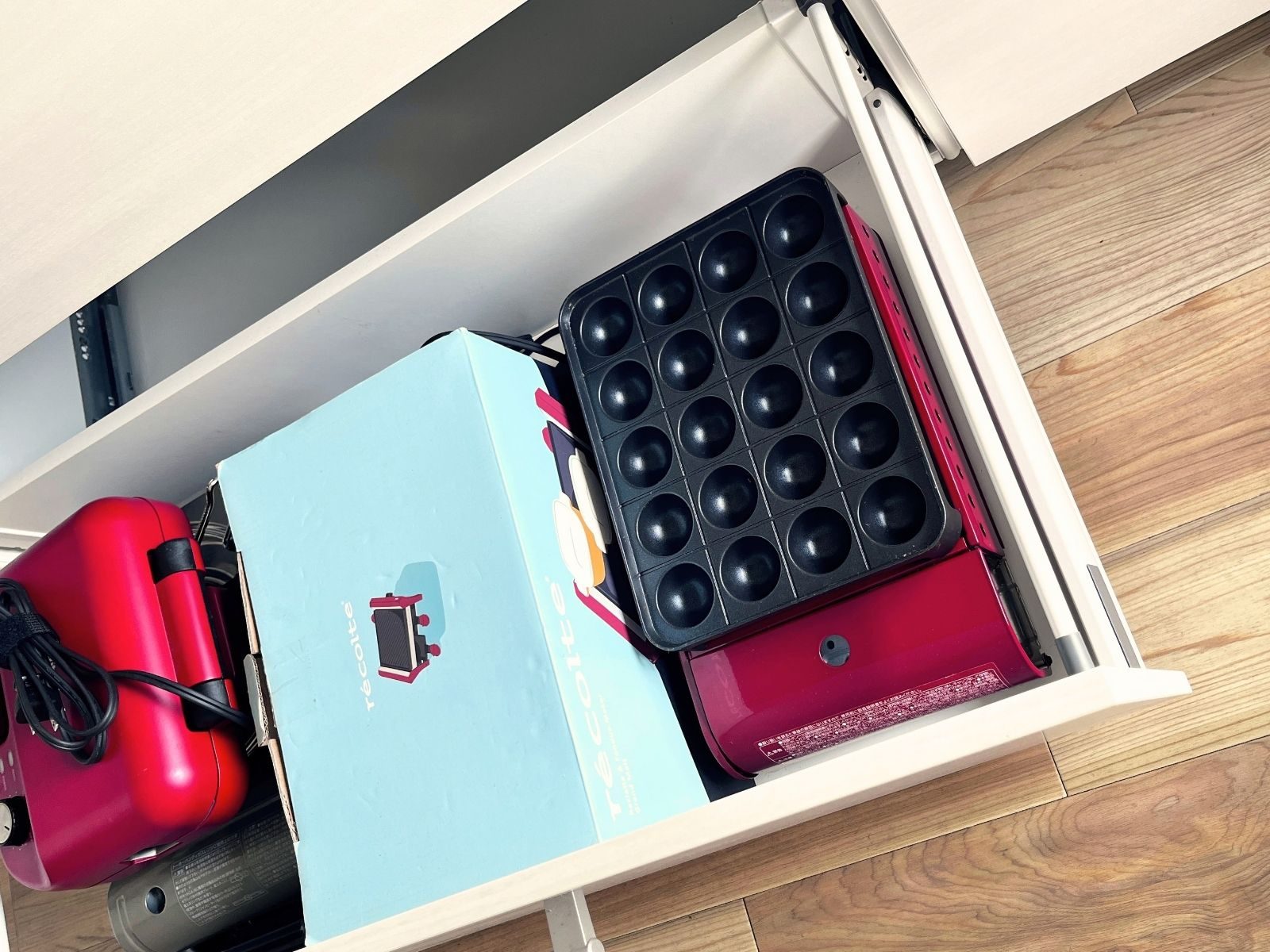
The drawer measures 45 × 43 × 33cm (17.5 × 17 × 13in) inside. The takoyaki maker is 34.8 × 23.1 × 13.3cm (13.5 × 9 × 5in), so it fits with room to spare.
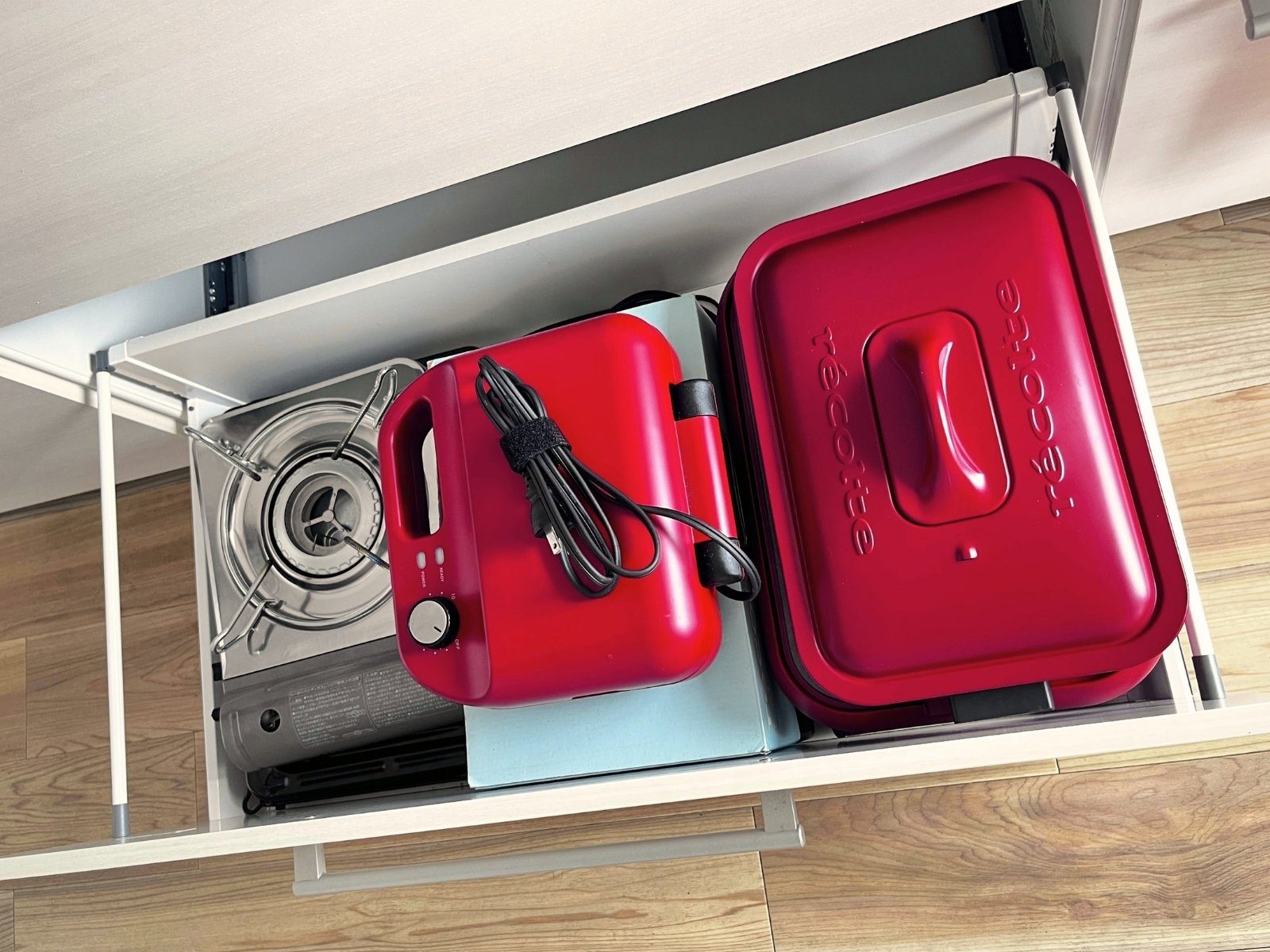
I throw the boxes away. Taking something out of a box is a step I’d rather not have, and the boxes take up space. The exception is anything with small loose parts — our raclette machine stays in its box for that reason.
Spare gas canisters live somewhere else, in the spot we use as a pantry.
Why butane is an option in Japanese homes
Many homes in Japan have a portable butane stove for the table. It’s there for nabe, the simmered hot pot dishes people cook at the table and eat as they go, which means the heat source has to be on the table.
So gas canisters are already in a lot of houses, and tabletop appliances that run on them make sense. That’s part of why butane takoyaki makers exist at all.
Japanese homes also often don’t have a large built-in oven, and there’s a wide range of tabletop cooking gear instead.
What the machine is
Mine is the Iwatani Super Entako (CB-TKS-R).
The specs:
- Body: 34.8 × 23.1 × 13.3cm (13.5 × 9 × 5in), 2.2kg (4.9lb)
- 20 molds, each 40mm (1.5in) across
- Maximum output: 1.74kW
- Gas use: about 127g/h (4.5oz/h). One canister runs about 110 minutes continuously
- Plate: die-cast aluminum with a nonstick coating, removable and washable
- Ignition: piezo, by turning the dial. Includes a pressure-sensing safety device
- Made in Japan
This model comes in more than one color. Mine is wine red (CB-TKS-R); there’s also a bronze and black version (CB-ETK-1). Going by the manufacturer’s replacement-plate listing, the same plate fits both.
In Japan it sells for around 9,700 yen (about US$63, depending on the exchange rate), as of September 2026.
When electric makes more sense
This isn’t about one being better. The conditions are different.
An electric maker works anywhere there’s an outlet. There’s no canister to buy and nothing extra to store. If your building has restrictions on gas appliances, or you’d rather not run an open flame indoors, electric is likely the better fit.
There are also electric models with removable plates. The 1,000-yen (about US$6.5) one I had didn’t have that, but if you check for it, the washing problem goes away.
What you can actually buy in the US
I’ll be straight about this part.
The takoyaki maker I use isn’t sold through official channels in the US. Iwatani’s US arm states that Iwatani products sold overseas are exclusive to that country’s market and can’t currently be imported.
There are proxy buying services that ship from Japan, but I wouldn’t count on it. Gas stoves are listed among the prohibited items on those services, and an order can go through and then be cancelled because the item can’t be shipped. Gas canisters themselves can’t go by air on any service.
What does exist is a setup the same manufacturer sells for the US market.
Iwatani’s US store carries a takoyaki grill pan (CB-A-TKP) that sits on a butane stove. It’s US$34.99 (as of September 2026), 26 × 21 × 3.9cm (10 × 8.5 × 1.5in), 730g (25.8oz), nonstick-coated aluminum alloy, 16 molds. The underside has grooves that seat onto the stove’s burner rack so it doesn’t slide.
The stoves are in the same store. For fuel, Iwatani’s US canisters (BU-6, 227g / 8oz) are sold on Amazon and at outdoor suppliers. The manufacturer says to use Iwatani-brand fuel with Iwatani gas appliances.
I don’t own this setup, so I can’t tell you how it cooks. This is a description of what it is, not a review.
There’s one difference worth knowing. My machine only makes takoyaki. The manufacturer’s accessory plates — for grilled meat, okonomiyaki and so on — aren’t listed as compatible with dedicated takoyaki machines. The plate-and-stove setup sold in the US can be swapped for other plates, so it does more than one job.
And to be clear: I couldn’t find manufacturer guidance on using a Japan-market appliance with US canisters. Since I can’t confirm that, I’m not going to suggest importing one.
The ingredients are available in the US
It isn’t just the equipment — you can get the ingredients on Amazon.com too.
- Takoyaki sauce (Otafuku, 300g / 10.6oz bottle). There’s a vegan version as well
- Takoyaki flour (454g / 16oz)
- Shirodashi and powdered dashi
- Takoyaki picks for turning the balls
Wrapping up
I started with a cheap electric one, moved to butane, and I’ve been using it for close to ten years. What decided it was a crisp outside and a soft center, and how much easier cleanup got.
We only use it a few times a year, but everything lives in one drawer, so it’s quick to get out when we want it.
And if octopus isn’t for you, what goes inside is up to you. I think that’s the best thing about this one.