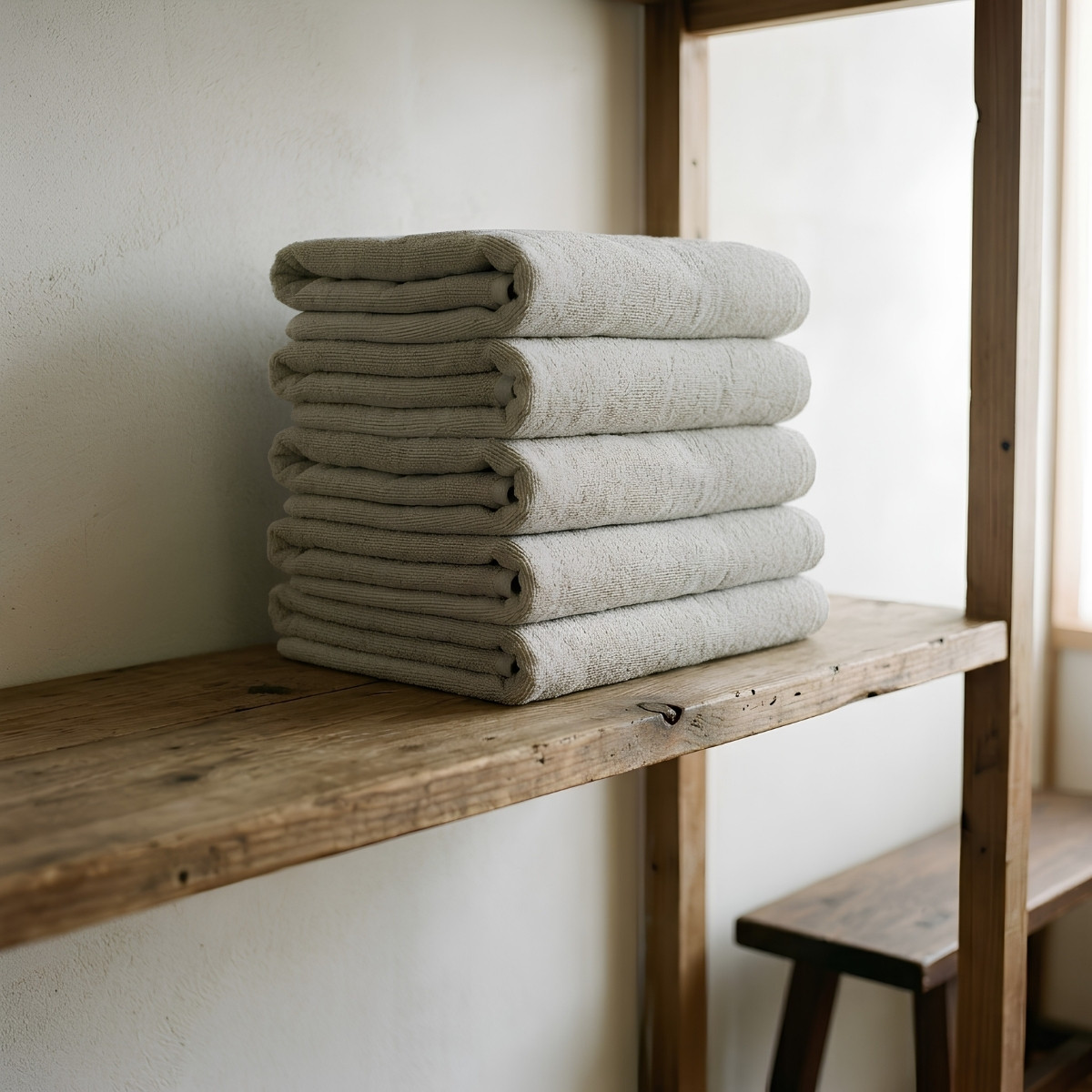
I have six bath towels. Same brand, same color, same size. I bought them as a set years ago, when I was living alone in central Tokyo, and they have been in rotation ever since. They are noticeably thinner than they used to be, and I had already decided it was time to replace them.
Then a phrase started going around in Japan this summer: バスタオルキャンセル, roughly “bath towel cancel.” Now I am not sure what to buy.
- It doesn’t mean skipping the towel
- Where the phrase came from
- Why I couldn’t just let it go past
- The day the dryer stopped being part of it
- Six towels is not a trial run
- I got out the tape measure
- I already had one in mind
- What the maker says about replacing towels
- What I’ve worked out so far
- If you keep the big ones, you need somewhere to put them
It doesn’t mean skipping the towel
Let me get this out of the way first, because even here some people read it the wrong way. “Bath towel cancel” doesn’t mean drying off without a towel. It means giving up the standard bath towel and using something smaller instead — usually a face towel, or a slightly longer version of one.
Where the phrase came from
The phrase traces back to an August 2026 article in Nikkei MJ, a trade paper covering retail and consumer goods, published by the company behind Japan’s main business daily. It reported a survey of around 500 people, roughly three in ten of whom said they had moved away from bath towels. From there it was picked up by aggregator sites, a podcast episode, and a press release from a towel maker that describes itself as one of the things that lit the fuse.
So the phrase arrived by way of a headline and some marketing rather than out of social media on its own, and the behavior it describes is a good deal older than the word. One Japanese towel maker has sold a “graduating from bath towels” line since 2018, and another has run an “I stopped using bath towels” line since 2006, both reporting sales in the millions of units. What’s new is the word, not the habit.
Why I couldn’t just let it go past
Most passing phrases go past me. “Bath towel cancel” caught because of what my laundry actually looks like.
We wash towels after every use. The two of us share six bath towels, and the laundry runs every two or three days, a little more or less depending on the season.
Where laundry dries depends on what you have. In our home it’s the balcony, or the bathroom’s drying function when the weather or the pollen count rules that out. In my grandmother’s, it’s a long pole in the garden. We can hang ours outside, though I’d rather the laundry weren’t visible from the street.
Laundry that dries slowly indoors can pick up a particular sour smell, and there is a whole category of detergent sold here for that problem. Running the bathroom dryer is partly how we stay ahead of it.
I got curious about how this works elsewhere and looked it up. The American Cleaning Institute suggests washing a bath towel after three to five uses, as long as it dries fully in between — which means the towel still hangs somewhere between uses, for a different reason. Somewhere to hang it is needed either way. I’d guess bathing habits and climate account for a good part of the difference.
When I read “bath towel cancel,” this daily routine is what I was picturing. A smaller towel takes up less of the drum, less time on the line, less room on the shelf, and might mean running the bathroom dryer on fewer days. I don’t know yet whether that adds up to enough. I couldn’t pretend it had nothing to do with me.
The day the dryer stopped being part of it
When I first bought these towels I was using a front-loading washer-dryer, and I dried them in the machine. I still remember how they came out. I like the look of towels that match, and running a matching set through the dryer felt like joining some better-kept version of adult life.
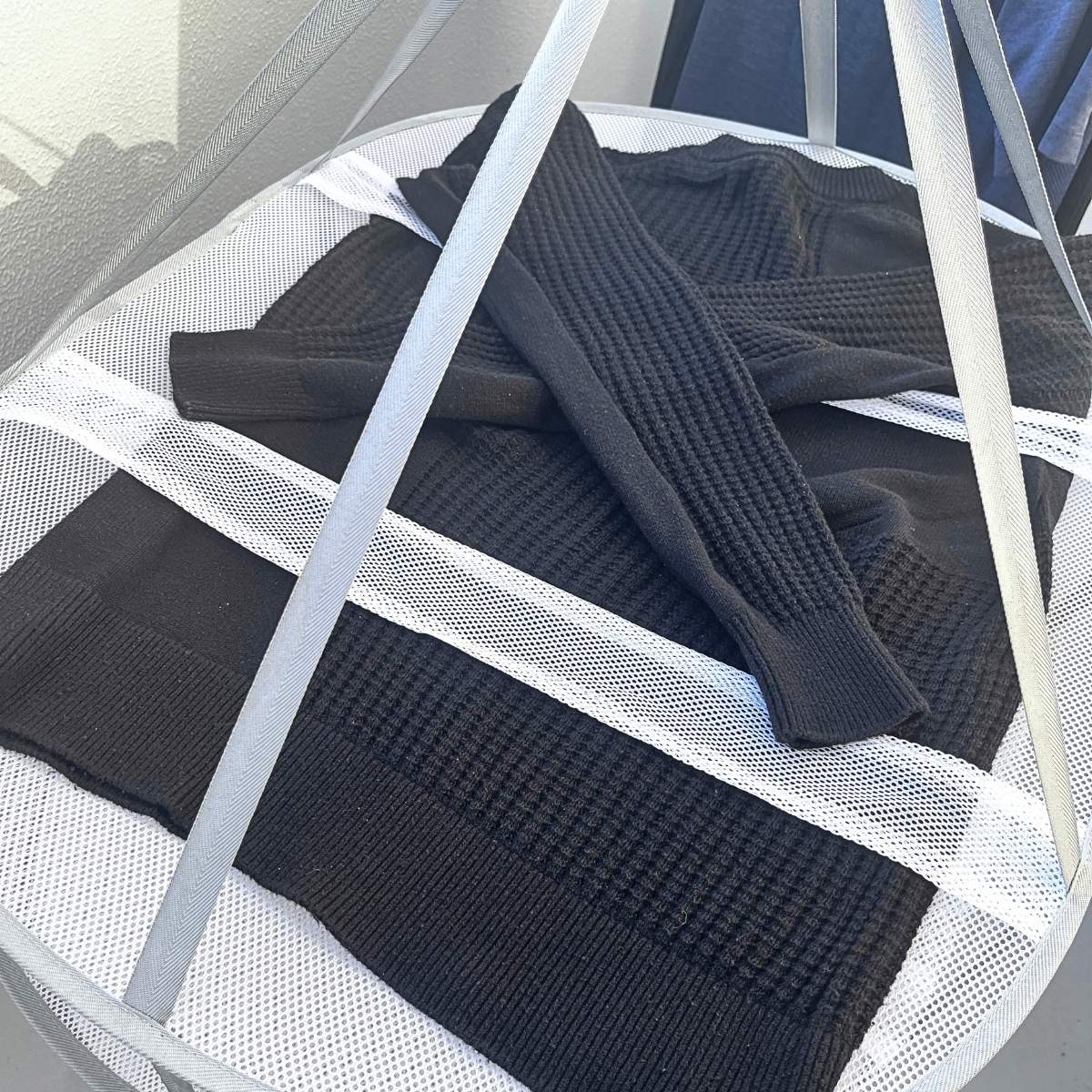
At some point the drying function stopped working. The machine still washes, so I kept it and started hanging the towels instead.
Same towels, different object. A front-loading drum washes by lifting the laundry and dropping it, and my sense is that this leaves the pile flattened — and with no dryer at the end to lift it back up, flattened is where it stays. I could replace the washing machine; it’s around ten years old. But the towels are the thing I want to change first.
To be clear about the order: I want new towels because the ones I have are worn out, not because the dryer broke. What losing the dryer changed is what I now need a towel to do. It has to dry hanging up.
Six towels is not a trial run
I’ve read a lot about bath towel cancel by now, and the people who buy their towels as a matched set don’t come up. That’s where I’m stuck.
My towels match. Same brand, same color, same size, bought together. That was deliberate: all one color, so the shelf looks a little like a hotel.
Which means I can’t test this. “Try a smaller towel and see how you like it” assumes you can buy one and slot it in. If your towels match, buying a single small towel breaks the set, and you’ll be looking at the odd one out every day until you decide. The real choice isn’t one towel. It’s all six at once, with no way back except buying six more.
For anyone whose towels are already a mix of sizes and colors, this problem doesn’t exist and switching is genuinely easy. It depends entirely on how you’ve been buying towels.
I got out the tape measure
I had no feel for how much smaller “smaller” was, so I measured what I have: 130 × 60cm (51 × 23.5in). The standard Japanese bath towel is 60 × 120cm (23.5 × 47in), so mine run 10cm (4in) long.
Then I looked up the ones I’d been walking past in the shop: about 50 × 100cm (19.5 × 39.5in). Some packages call that a mini bath towel and some call it a big face towel, and the measurements are the same either way — it sits right on the boundary, and the brands haven’t settled which side it belongs to. Below that is the face towel, about 34 × 80cm (13.5 × 31.5in).
For anyone reading outside Japan, I looked up your numbers too. A bath towel there tends to run around 70 × 135cm (27.5 × 53in), and a bath sheet around 100 × 160cm (39.5 × 63in). So the standard Japanese bath towel is already smaller than a US one, and the size I’m weighing lands somewhere between a US hand towel and a US bath towel. Measure a towel you already own before deciding whether 50 × 100cm (19.5 × 39.5in) sounds usable.
I already had one in mind
Before any of this, I had a good idea of what I’d buy next: タオル研究所, Towel Kenkyujo — literally “towel laboratory” — made by Izawa Towel, a Tokyo manufacturer founded in 1970 that spent most of its history producing towels under other companies’ labels.
My reasons: the review counts were enormous, which I took as a rough signal that quality is consistent; the price per towel worked for replacing a whole set; and the colors were ones I’d want on the shelf.
The range is split into numbered series. The two I’d stopped on were #003 Volume Rich and #024 Natural Softness, both 480 GSM, which the brand calls hotel specification.
GSM is grams per square meter of fabric, and it’s the usual shorthand for how thick a towel is. Looking it up, the common reading is that 300 to 400 GSM is light and quick-drying, 400 to 600 is the everyday middle, and above 600 is the plush hotel range that takes longer to dry. So 480 GSM isn’t as thick as the name suggests. It’s the middle of everyday.
That’s where I stopped. The same brand’s #006, at 305 GSM, is sold as the quick-drying one. A thicker towel holds more water and takes longer to dry — per towel, that’s roughly 346 g against 220 g of cotton. Choosing on review counts and color, I hadn’t been looking at that at all.
Prices below are from the brand’s own Rakuten shop as of September 2026; dollar figures are approximate and move with the exchange rate.
| Series | Mini bath towel, 50 × 100cm (19.5 × 39.5in) | Bath towel, 60 × 120cm (23.5 × 47in) |
|---|---|---|
| #003 Volume Rich, 480 GSM | ¥3,323 for five (about US$21), ¥665 each (about US$4.3) | ¥3,626 for four (about US$23), ¥907 each (about US$5.9) |
| #024 Natural Softness, 480 GSM | same | same |
| #006 The Reason for Lightness, 305 GSM | ¥3,000 for five (about US$19), ¥600 each (about US$3.9) | ¥3,000 for four (about US$19), ¥750 each (about US$4.8) |
For my six, that’s about ¥3,990 (about US$26) in the smaller size against about ¥5,442 (about US$35) in the standard one — a difference of about ¥1,452, or about US$9.4.
And then there’s the one I keep opening and closing: #052 Dry Keep, 500 GSM, sold specifically as tumble-dryer safe — ¥4,636 for four bath towels (about US$30), or ¥1,159 each (about US$7.5). About 30% more than #003.
My dryer doesn’t work, so on paper this one isn’t for me. But the washing machine is ten years old too. If I replace it, I’m back to drying towels in the machine. So what I can’t settle is whether I’m buying towels for the laundry I do now, or for the laundry I might be doing next year. Buying the dryer-safe ones today means buying for a machine I haven’t bought.
It doesn’t come in the smaller size, either.
What the maker says about replacing towels
On its own site, the brand suggests replacing towels every three to six months, and points to falling absorbency and surface fluff as the signs. Mine have lasted years, so I’m past that on any reading of it.
Two other things from the same guidance that seem useful in a house without a dryer: skip fabric softener, since it can reduce absorbency, and shake the towel out a few times before hanging it, to get some air back into the loops.
What I’ve worked out so far
The smaller size makes sense for the way my laundry actually works now. It would dry faster on the line, take less room on the shelf, and cost a little less to replace.
I’ve used 130 × 60cm (51 × 23.5in) for long enough that I don’t know how 50 × 100cm (19.5 × 39.5in) will feel after a bath. Then again, plenty of people are doing exactly that and getting on fine, which is presumably how the phrase traveled as far as it did. Whether it’s enough probably isn’t decided by the size of the towel alone.
And replacing six matching towels at once is a bigger decision than the price suggests. I’ll write about it when I decide.
If you’re in the same place — towels worn out, unsure whether to size down — take your time with it, and think about how your own days run: where the laundry dries in your home, and how much of the work you want it to be.
If you keep the big ones, you need somewhere to put them
Whichever size you land on, a wet towel has to hang somewhere: here after every wash, and in a house where towels get reused, between uses. I wrote separately about the freestanding rack we use, and that’s where the size question first caught me out. The lowest of its bath-towel bars sits 69cm (27in) off the floor, so a 130cm towel hangs with its hem just clearing the ground. The rack is built to Japanese dimensions, and anything longer reaches the floor.