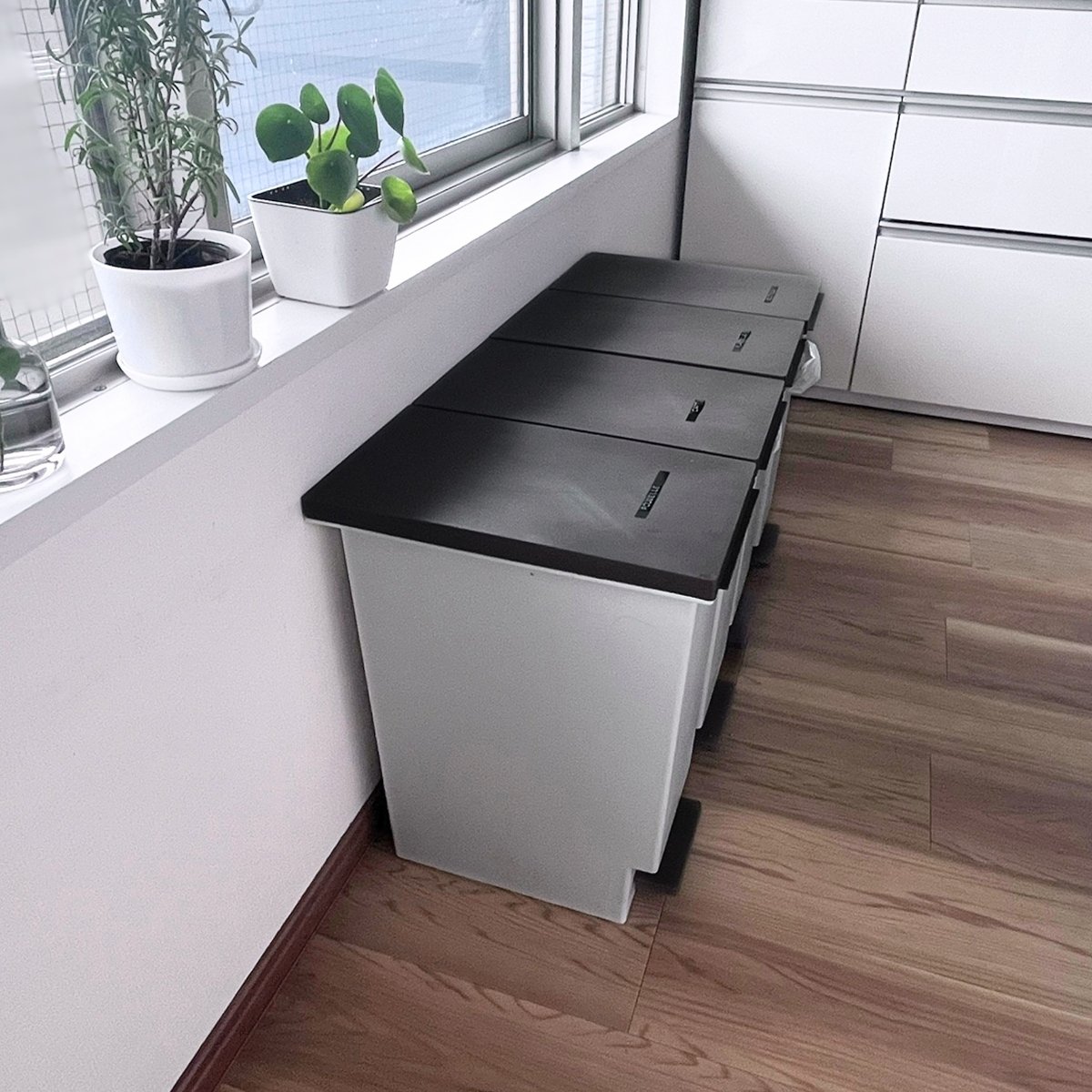
There are four trash cans on my kitchen floor. Together they take up about 80cm (31.5in) along the wall under the window.
Each one is about 20cm (8in) wide, 35–36cm (14in) deep, and 43–45cm (17–17.5in) tall, and holds 20L (5.3gal). They are white pedal cans with brown lids, lined up in a row: burnable waste, paper, plastic, and plastic (PET) bottles.
Four separate streams fit in that space. Not because anyone in my house is unusually organized, but because of how the local rules work, and because many bins sold in Japan are designed to line up side by side.
If you are trying to sort more than one kind of waste in a kitchen that has no room for it, the way bins are sized here may be useful to you. This is what I actually have, what I had before, and what I would look at if I were buying again.
- How many bins you need depends on where you live
- Why width is the number to look at
- Separating by frequency, not just by category
- What to do when you can’t fit four
- Why lids and pedals
- Four of the same thing, on purpose
- Food waste doesn’t stay in the kitchen
- Labels, for people who don’t know your house
- What to buy, and where
- The short version
How many bins you need depends on where you live
Household waste sorting in Japan is set by the municipality, not nationally. The categories, the collection days, and what counts as “burnable” are decided locally, which means they change when you move.
I have moved several times, and the number of bins in my kitchen has changed with each move — not only because the kitchens were different sizes, but because the rules were.
In central Tokyo, a fairly wide range of things could go in with burnable waste. In Yokohama, where I live now, more of it is separated out. Some of what I used to put in one bag now goes into three. The difference is not about one place being stricter in principle; the two systems simply draw the lines in different places, and each household adapts to whichever set of lines it lives under.
Collection days follow the same pattern. Burnable waste is often collected around twice a week, with recyclables on their own days, and you do not choose the schedule — it applies to your street. So waste sits in the house between collections, and the bins have to be able to hold it.
There is also a fair amount of personal judgment involved. Plenty of things could technically go in the burnable bag and still be accepted, and plenty of households separate them anyway because the collection exists. I sort to the level that fits our week, and I know the level differs from house to house.
For what follows, that matters in one practical way: the right number of bins is the number your local rules and your own habits actually produce, not a fixed figure. Four happens to be right for us. It might be two or six for you.
Why width is the number to look at
Search for a kitchen trash can on a Japanese retailer’s site and you will often find two filters side by side: capacity in liters, and width in centimeters.
The width filter exists because most people are fitting a bin into a specific gap — beside the fridge, under a counter overhang, in the space between a cabinet and a wall. The gap is fixed. The bin has to be chosen to match it.
The result is a lot of narrow, tall, rectangular bins in the 20–30cm (8–12in) width range, sized so that two or three of them can sit side by side in the space one larger can would occupy. Mine are about 35cm (14in) deep. They sit along a walkway, and I chose that depth so there is still room for someone to walk past.
Height matters for a reason that is easy to miss. Mine are 43–45cm (17–17.5in) tall, well below counter height. In my kitchen they sit against a low wall with a window above it, and I chose a height that stays clear of the window. A taller can in the same spot would have gotten in its way.
If you are shopping with a gap in mind, the order that works is:
- Measure the gap — width, depth, and the height of anything above it.
- Subtract a little from the width. Lids and pedals need clearance, and cans with a lid that swings up need room above.
- Then choose a capacity that matches how much waste builds up between collections. That depends on how many people live in your home and how often collection comes. There are two of us, and food scraps mostly go to our composter, so 20L (5.3gal) is enough for our burnable waste with collection twice a week.
Measuring the gap before anything else is the part I would carry over to any kitchen, in any country.
Separating by frequency, not just by category
The thing that made sorting manageable in a small space was not buying more bins. It was noticing that the categories are not equally busy.
Four things come up nearly every day in our house: burnable waste, paper, plastic packaging, and PET bottles. Those get a can each, at floor level, where they are easy to use without thinking.
Other categories come up occasionally — batteries, glass jars, a few other things that are collected separately but only accumulate slowly. Those do not get cans. They live in small baskets in the bottom drawer of the kitchen cabinet. They are out of sight, they take no floor space, and I take them out when they have built up rather than at every collection.
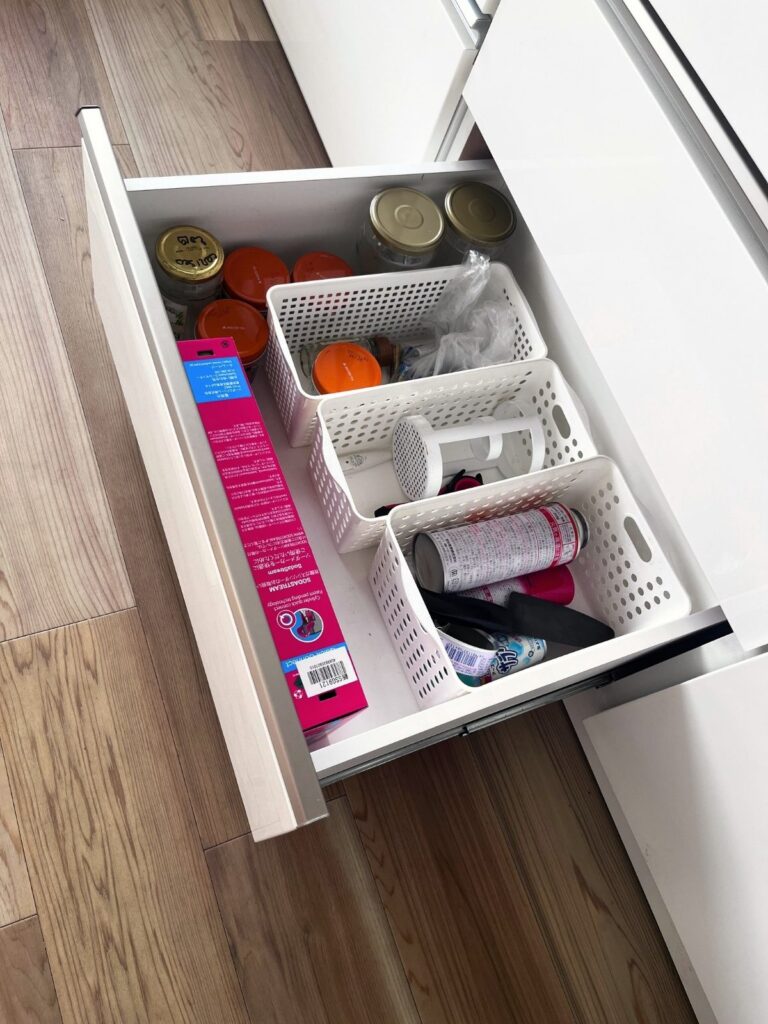
Put simply:
- Daily streams → a can each, out in the open
- Occasional streams → a basket or box, put away
Splitting it that way is what keeps the floor row down to four. If every category had needed its own can, there would be no space for them, and I suspect the sorting would have quietly stopped happening.
What to do when you can’t fit four
Before this apartment, I had a smaller kitchen, and I had exactly one trash can: a larger pedal can with a lid, for burnable waste.
I did not have a row of cans for years. One can was what the kitchen allowed, and the sorting I did was adjusted to fit — helped by the fact that the rules where I lived then put more things into the burnable category to begin with.
If you are in a kitchen where four cans will not fit, some things that work:
- Let the main can be the one you use constantly, and give it the best position. The stream you touch twenty times a day is the one that decides whether the system survives.
- Handle the rest with bags rather than cans. A bag hung inside a cabinet door, or tucked into a corner of a cupboard, costs nothing and takes no floor space.
- Use a drawer or a shelf for anything slow. The basket approach above works whether you have one can or six.
- Go vertical only if the lid still opens. Stacked two-tier cans exist and are genuinely narrow, but check the clearance above before buying — a can that cannot open fully in its gap is harder to live with than a shorter one.
The honest version is that a small kitchen limits how finely you can sort, and there is no arrangement of products that removes the limit entirely. What you can do is make sure the space you do have goes to the stream that uses it most.
Why lids and pedals
All four of mine are pedal cans with lids. A few reasons.
Your hands are usually full. Cooking means wet hands, greasy hands, a handful of peel. A foot pedal opens the can without any of that touching the lid.
The lid is there mainly because I would rather not see what is inside. With four cans in a row in the kitchen, closed lids keep it looking tidy.
I also like a lid that opens right away. Some cans open slowly, including motorized ones, but when I am throwing something out, I do not want to stand and wait for the lid. Ours are plastic, so the lids are light and do not make much noise when they drop shut. It has never been something I needed to think about.
There is a practical side as well. We have moved several times, and the space for trash cans has been different in every kitchen, so heavy, expensive cans were not really on the list for us. If you own your home and expect to stay, that trade-off may look different.
Four of the same thing, on purpose
All four cans are the same model, in the same colors. That was a deliberate choice. Besides the depth and the height, I wanted a design that suits the rest of our kitchen.
Four cans in a row take up visual space, not just floor space. Four different sizes and colors can read as clutter even when everything in them is sorted correctly. Four identical ones tend to read as a single block, and the eye passes over them.
In a small kitchen this matters more, not less. The cans are already taking a share of the room; matching them is what keeps them from also taking a share of the attention.
If you are building a row over time rather than buying all at once, it is worth checking that the model you start with is still in production. Ours were bought together, which made it easy — replacing one of four a few years later is the situation where a discontinued model becomes a problem.
Food waste doesn’t stay in the kitchen
There is no compost bin in my kitchen, and no fifth can for food scraps.
What I use instead is a stainless steel mixing bowl on the counter. Peels, shells, trimmings go in as I cook. When I am done, it gets emptied and washed with everything else.
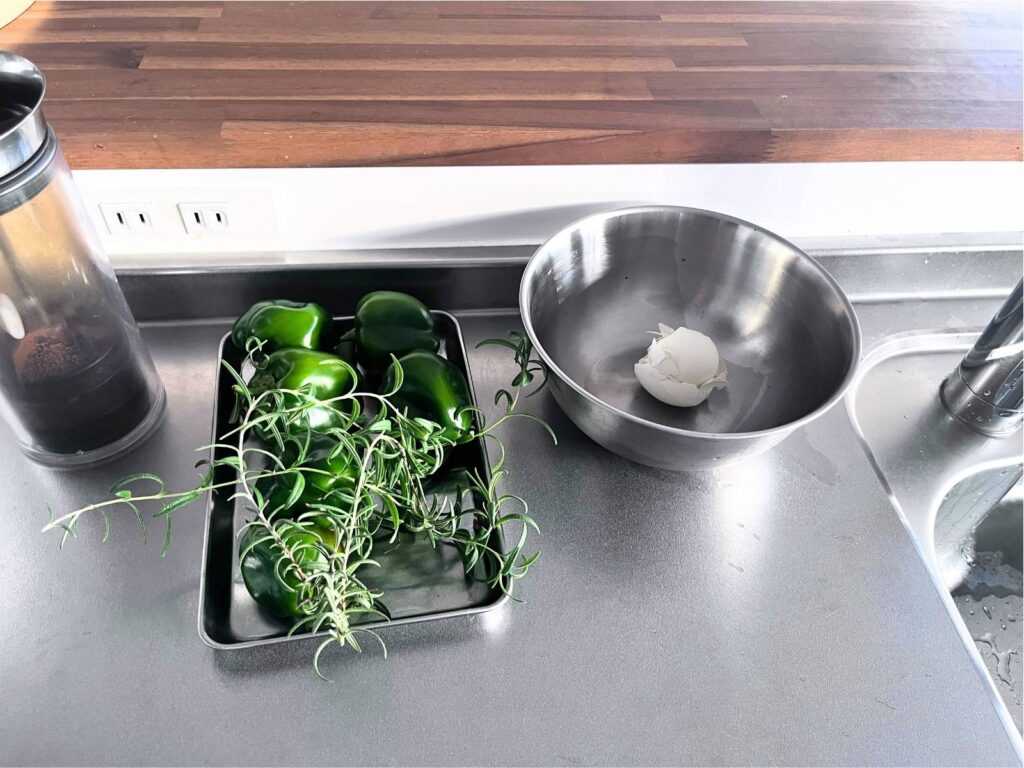
I did not buy anything for this. Countertop compost bins with charcoal filters exist and are sold specifically for the job, but a metal bowl does not absorb smells, does not stain, washes in seconds, and was already in the kitchen. It is also open, which sounds like a drawback and mostly is not, because it gets emptied at the end of cooking rather than sitting for days.
Where it gets emptied is a soil composter on our roof balcony — a Japanese type called a kiero, which uses soil to break the waste down. Food waste goes into it and, given time, disappears into the soil.
Two honest notes, because this is the part that usually gets written up as tidier than it is.
Not everything goes in. Bones and shells take too long to break down, so they go out with burnable waste.
And I don’t always use it. The roof balcony is at the opposite end of the apartment from the kitchen — the longest walk in the house. On days when I cannot be bothered, the bowl gets tipped into the burnable can like anyone else’s food scraps. For me, whether I use the composter comes down to that distance more than anything else.
The part worth taking from this is smaller than the composter: the container that holds food waste during cooking does not have to be a trash can, and does not have to be bought.
Labels, for people who don’t know your house
Four identical cans in a row give no clue about what goes in which one. We know because we filled them.
When my mother-in-law came from France to stay with us, that stopped being fine. She was cooking in the kitchen, generating waste like anyone would, and there was no way to tell the cans apart by looking.
So we labeled them — in French, since that is what she reads. POUBELLE, CARTON, PLASTIQUE, BOUTEILLE. Small embossed strips on each lid. They are still there.
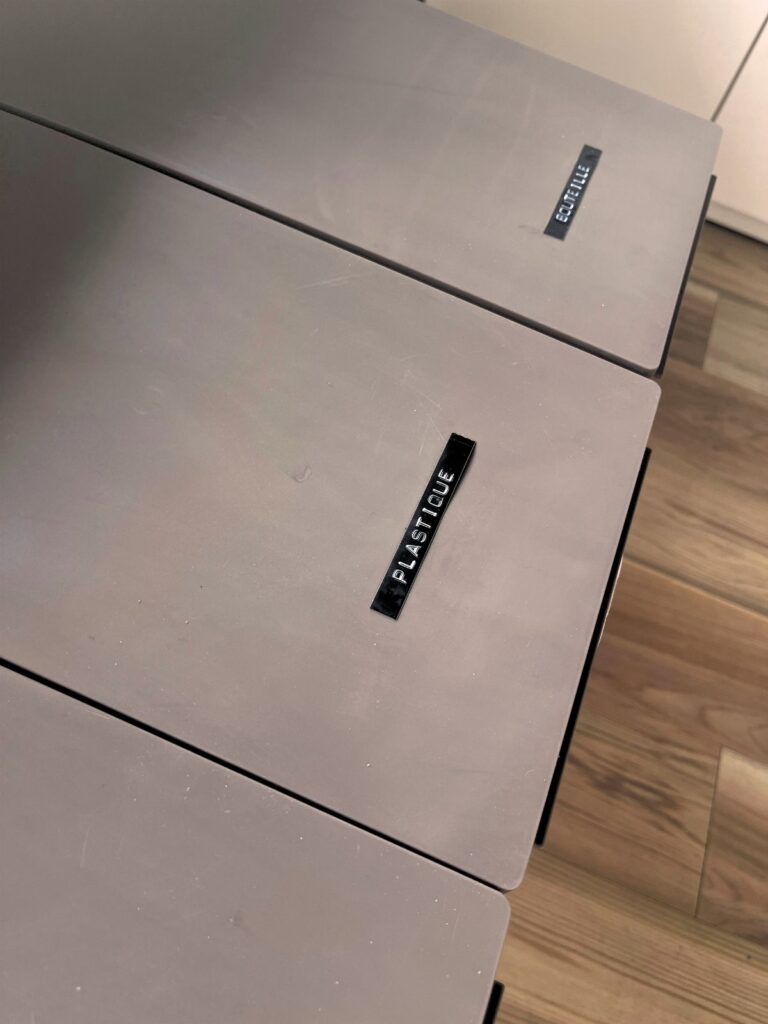
This is the one thing in this article that costs almost nothing and solves a real problem. Sorting systems can be invisible to anyone who did not set them up — a guest in Japan, a roommate, a new household member, or a visiting family member anywhere. A label removes the guesswork without a conversation, and without anyone having to remember a set of rules they will only need for a week.
If you sort into more than two streams and anyone else uses your kitchen, label them.
What to buy, and where
A note on what is realistic to get hold of, depending on where you are.
Available where you are: Yamazaki Home
Yamazaki Home is a Japanese manufacturer whose tower line covers a lot of the small-space fittings described above, including trash cans. They do not run their own shops — in Japan you usually meet their products on someone else’s shelf, at Nitori or a home goods store, and learn the brand name afterward. The same is true abroad: in the US they are carried by The Container Store, west elm, Wayfair, Crate & Barrel and Amazon, alongside their own online store.
This is the straightforward option if you are reading from outside Japan. It ships domestically, and returns are much simpler than with an order from overseas.
Japan-only: TONBO
The cans in our kitchen are made by TONBO (Shinkigosei), a Japanese plastics manufacturer. Not a shop — a maker, whose products turn up in home goods stores, hardware stores and online here. Ours are the Neo Color slim pedal can, 20 liters, white with a brown lid.
The measurements are the ones quoted throughout this post: 20cm (8in) wide, 35.5cm (14in) deep, 45cm (17.5in) tall, 1.1kg (2.4lb) each. They cost under ¥1,000 apiece (about US$6–7), as of September 2026.
What is worth looking at is the rest of the range, because it makes the width argument better than I can:
| Capacity | Width | Depth | Height |
|---|---|---|---|
| 20L (5.3gal) | 20cm (8in) | 35.5cm (14in) | 45cm (17.5in) |
| 30L (7.9gal) | 23.5cm (9.5in) | 41.5cm (16.5in) | 49.5cm (19.5in) |
| 45L (11.9gal) | 26.5cm (10.5in) | 45.5cm (18in) | 55.5cm (22in) |
Same shape, three widths, each about 3cm (just over an inch) apart. That lineup exists because people are buying to fit a gap, and the gap is what varies. It is a clear illustration of choosing by the space first.
Getting them outside Japan means a proxy service. These are sold mainly through Rakuten rather than Amazon, and proxy services cover Rakuten, so they are reachable. Whether they are worth reaching is another matter — see the shipping caution below.
One thing I would add, having looked this up while writing. I had assumed for years that most of our cans came from Nitori, the large home furnishings chain, because that is where I have bought trash cans in the past. These ones are not Nitori’s own product. Stores here carry a mix of their own lines and other manufacturers’ goods, so “bought at Nitori” and “made by Nitori” are not the same thing — something to keep in mind if you are trying to track down a specific item you saw in a Japanese home.
One caution worth taking seriously: trash cans are light but bulky, and international shipping is usually priced by volume. A 20L can may cost more to ship than to buy. If you are ordering from Japan, small and dense items are the ones that make sense; trash cans generally are not, unless you have a specific reason to want that exact product.
If you would like the full comparison of proxy services, fees and timelines, it is in my guide to ordering from Japan.
The short version
- Measure the gap first — width, depth, and the clearance above. Then pick a capacity that suits your household and your collection schedule.
- Narrow, shallow cans tend to work better against a wall than tall, deep ones.
- Keep a can for each stream you produce daily. Everything occasional goes in a basket in a drawer.
- If only one can fits, give it to your busiest stream and handle the rest with bags.
- A lid keeps the contents out of sight, and a pedal keeps your hands off it.
- Food waste does not need a dedicated can during cooking. A bowl works.
- If anyone else uses your kitchen, label the cans.
The row in my kitchen is four cans and 80cm (31.5in) because that is what this apartment and these local rules produced. Yours will land somewhere else. The measuring is the part that transfers.