My dryer has been broken for years, so almost everything I wash gets hung up to dry. Here’s where it all goes in my apartment in Japan, and the tools that help.
This post contains affiliate links (see my disclosure for details). As an Amazon Associate I earn from qualifying purchases.
Three Spots, One Broken Dryer
Our washing machine is a combo washer-dryer, and the dryer side has been broken for years. It’s an old machine — old enough that parts for it are hard to find now — so fixing it isn’t really on the table. Even so, I didn’t replace it. Some people would, of course, but our washer and dryer are one combo unit, so replacing it for the dryer would mean replacing a washer that still works. To me, a dryer is a bit like a robot vacuum: it’s handy because it does the job for you, but when it breaks, you go back to vacuuming yourself. So I went back to my original option, hanging things to dry: outside, or in the bath with its built-in dryer running. And even with a working dryer, knits and other clothes that can shrink or get damaged get hung up anyway, so hanging everything feels like an extension of that. I’ve built three different spots around the apartment for drying laundry, depending on the weather and what needs to dry. In my apartment, as in a lot of Japanese homes, the bath itself is a separate, waterproofed room from where the sink and washing machine sit — I’ll call the bath itself the bathing room, and the outer room the washroom.
A 2025 survey by Rinnai, a Japanese appliance maker whose products include gas clothes dryers, found that 73.7% of respondents in Japan usually hang laundry outside on sunny days, while 66.9% switch to drying indoors on rainy days, which lines up closely with my own routine. Owning a dryer doesn’t always mean using it, either. Even back in 2013, a survey by Tokyo Gas’s Urban Life Research Institute, which studies everyday home life in Japan, found that about 6 in 10 households with a washer-dryer rarely or never used the drying function, with energy costs and drying time as the top reasons. In Japan, I think the basic idea is still that laundry is something you hang outside. In summer, things hung outside dry so fast that I can run the washer more than once a day. Apartments here often come with pole brackets already on the balcony, like mine did. It isn’t only clothes, either. Outside the city, I often see futons hanging in yards and over balcony railings on sunny days. My grandmother airs hers in the sun and loves what she calls “the smell of the sun.”
The Balcony: Where the Rod Was Already Waiting
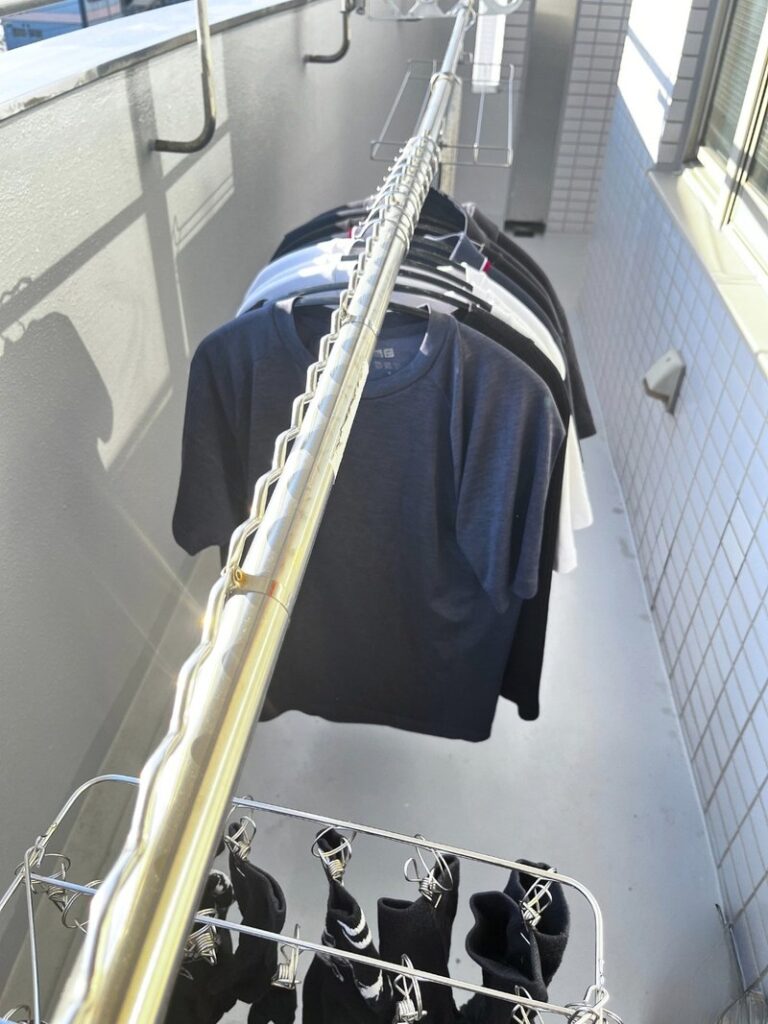
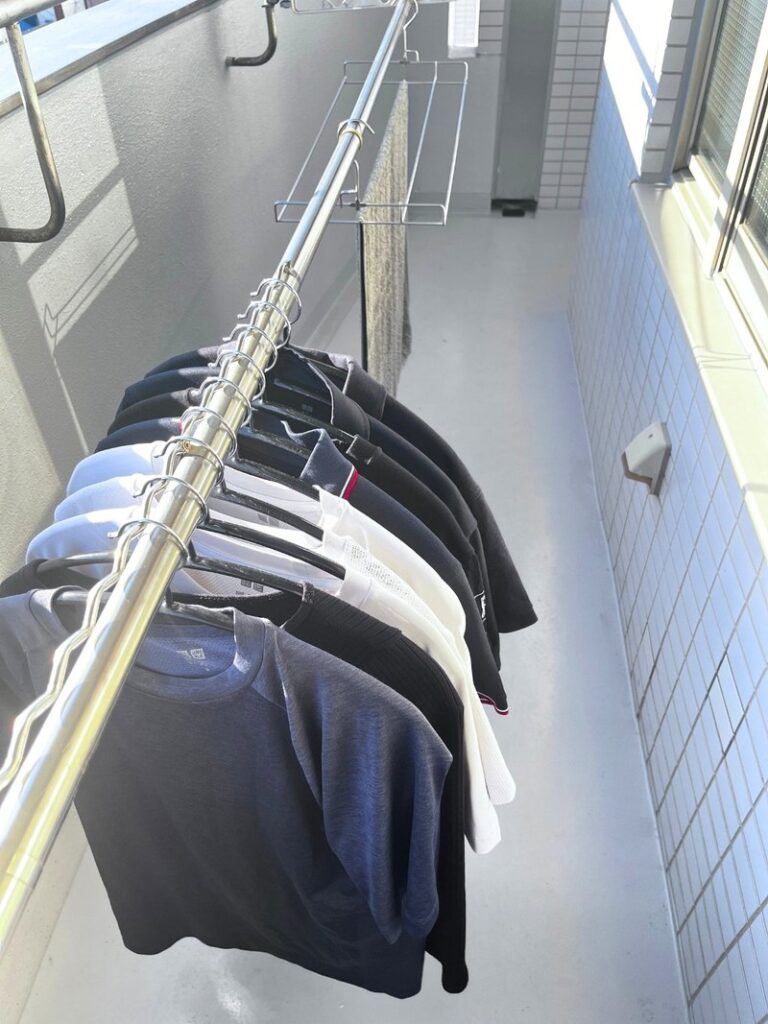
On sunny days, laundry goes on the balcony. Two bracket-style holders are mounted on the balcony wall — they came with the apartment — and I bought a telescoping pole to rest across them.
The holders have a row of holes for adjusting how far the pole sits from the wall. I use the outermost hole, because anything closer means the laundry brushes against the wall as it dries.
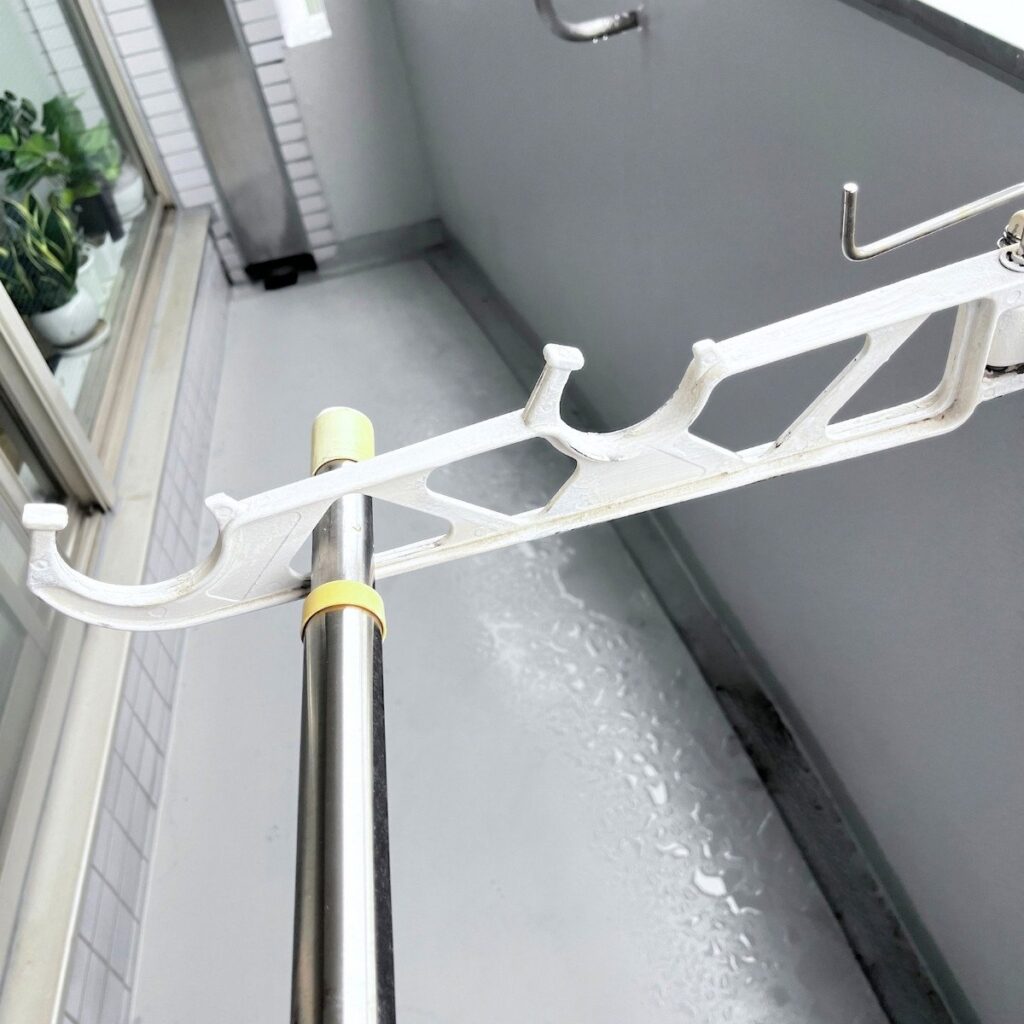
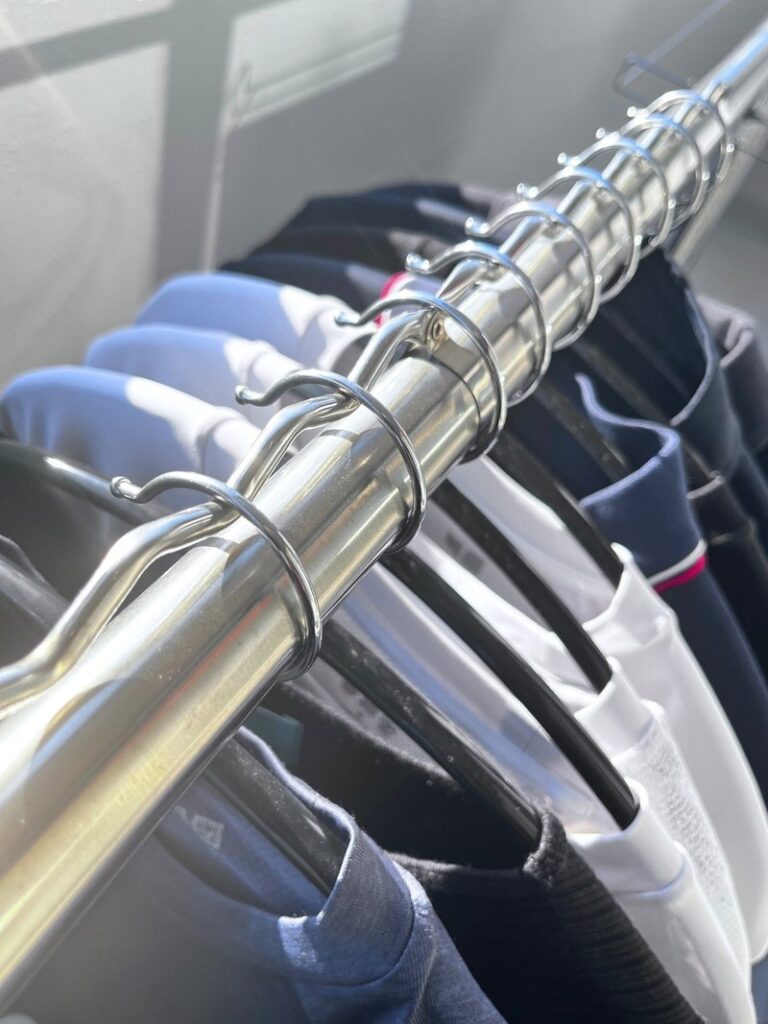
The pole itself is a telescoping type from Nitori — a Japanese home goods chain often compared to IKEA — sold in two length ranges, with the longer one rated to hold less weight than the shorter one (exact sizes below). Which length you need depends on where the brackets are mounted, which is why they’re sold adjustable rather than fixed. Mine telescopes (the ring partway along is the lock: loosen it to slide the pole longer or shorter, tighten it to hold the length) and has a wavy wire running along the top, so a single hanger sits in each dip rather than sliding toward one end and bunching up on a windy day. Several Japanese makers, including Nitori, sell poles with features like these.
If your balcony doesn’t have built-in bracket holders like mine, there are pole stands that simply clamp onto the railing instead, no drilling required — worth knowing about if you’re renting.
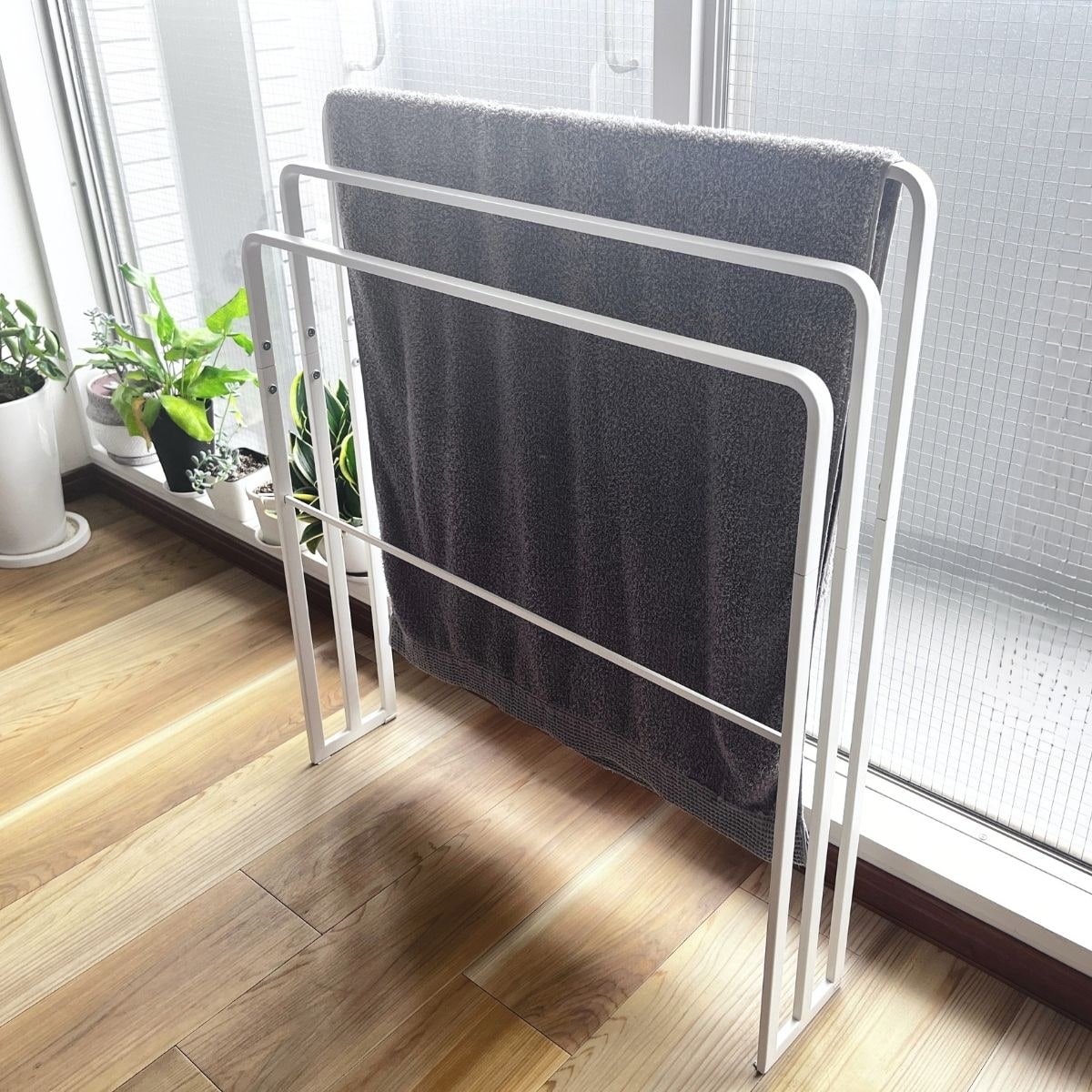
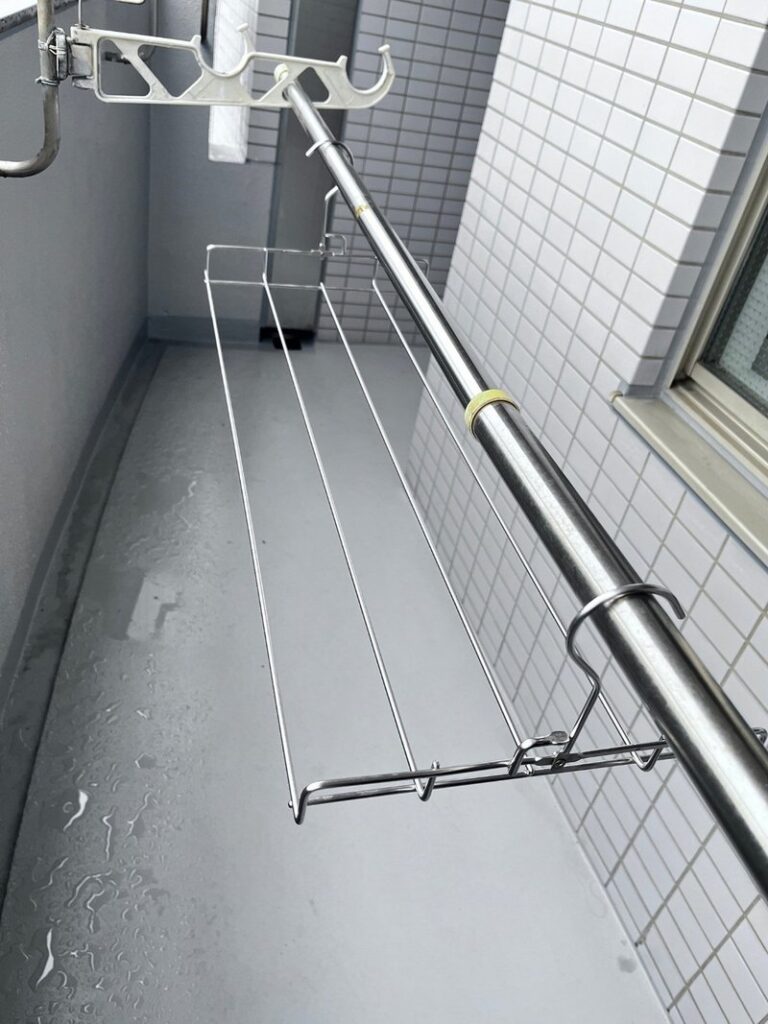
Bath towels get their own accessory: a sturdy, flat wire rack from Shimomura Kihan, a Japanese houseware maker, that clips onto the pole with two hooks. Each bath towel folds in half over one of its bars, so five can hang side by side to dry, and the rack itself folds down to a fraction of its size when the hooks are tucked in for storage (exact dimensions below). The two hooks face opposite directions, which keeps the whole thing from sliding off the pole in wind. Mine has sat outside on the balcony since 2024 without rusting. It’s made from 18-8 stainless steel, which is known for corrosion resistance. I picked this one for two reasons: it doesn’t eat up width on the pole, and it looks sturdy and put-together. I could just hang bath towels directly over a longer pole, but that would use up the pole’s whole width and leave no room for anything else. And because my pole sits at chest height, hanging towels from something like a stainless pinch hanger (a flat frame with a row of clips hanging underneath, more on that below) would let even a hand towel touch the floor. (It solves a different problem from the freestanding rack I use for used towels waiting on laundry day — that one is about parking towels indoors between washes, this one is about drying them outside.) Personally, I think it could work for drying towels in a bathroom, too.
The Bathing Room: Built-In, But With a Catch
It’s only on rainy days, or during pollen season, that laundry goes in the bathing room instead. A drying pipe runs across it, installed as part of the room’s ceiling dryer/heater unit — it wasn’t something I bought separately.
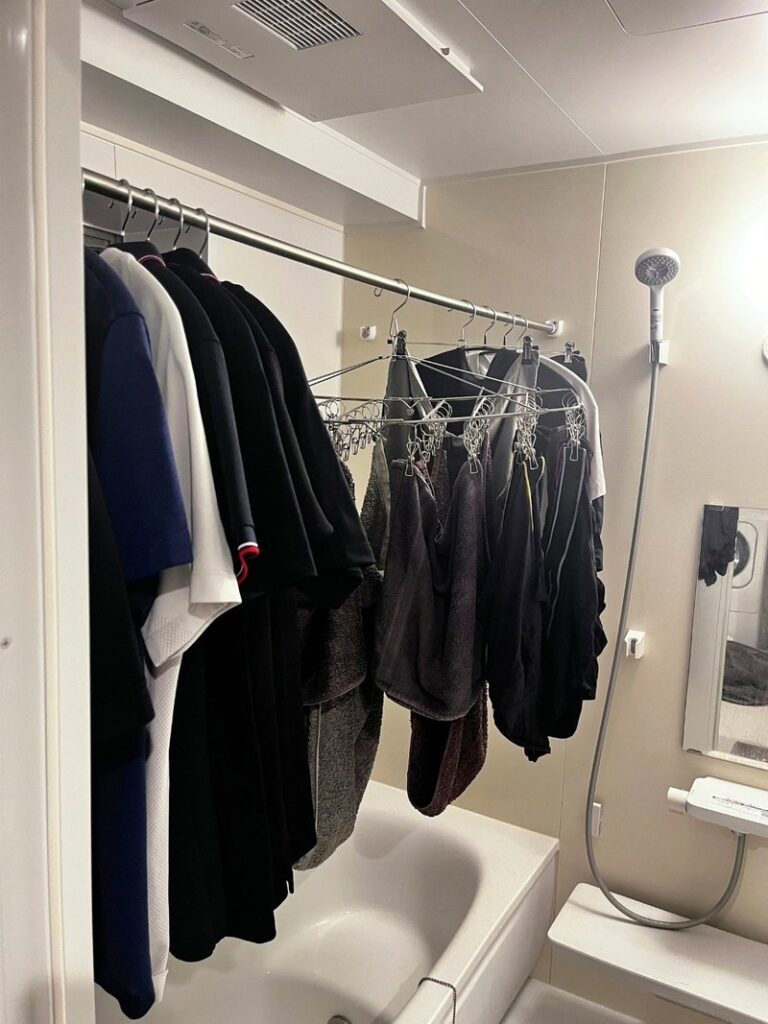
This kind of built-in dryer is common enough in newer buildings in Japan, though it’s not something every home has. A 2026 survey by Japan’s Cabinet Office found that 56.5% of households of two or more people have some kind of clothes dryer: 40.8% have a combo washer-dryer, and 26.3% have another type, a category that includes bathing-room dryers like mine (some homes have both). Dryers in general — combo washer-dryers, standalone units, and bathing-room units alike — seem to be getting more common in recent years, though. Every apartment I’ve personally lived in has had one, but that isn’t necessarily true everywhere.
I just press a button for the clothes-drying setting and run it for 4 hours, and add more time if things are still damp. It works well, but there’s a real downside: while it’s running, the room is out of use for anything else. If someone wants a shower partway through, all the laundry has to be moved out first.
There’s one more thing that makes drying laundry in the bathing room harder for me. I’m oddly sensitive to the sound and vibration of metal scraping against metal, and hearing it sends a shiver down my back. The drying pipe here is metal, and so are the hooks on my pinch hangers, so I try to keep them from scraping against each other while I hang things. The balcony’s pole sits at about chest height, so hanging things there is more of a set-it-down motion, which doesn’t bother me much. This room’s pipe is above head height, though, more of a reach-up-and-hook motion instead. There’s no real trick to keeping it quiet. I just hook each hanger on as gently as I can.
Above the Washer: Not for Drying, But Still Useful
The washing machine sits in the washroom, and the space above it has a tension rod. I put it up myself — it’s the one part of this setup that didn’t come with the apartment. (For more on how the rest of that space is organized, see my piece on Japanese bathroom and kitchen storage, and on a no-drill shelf built the same way.)
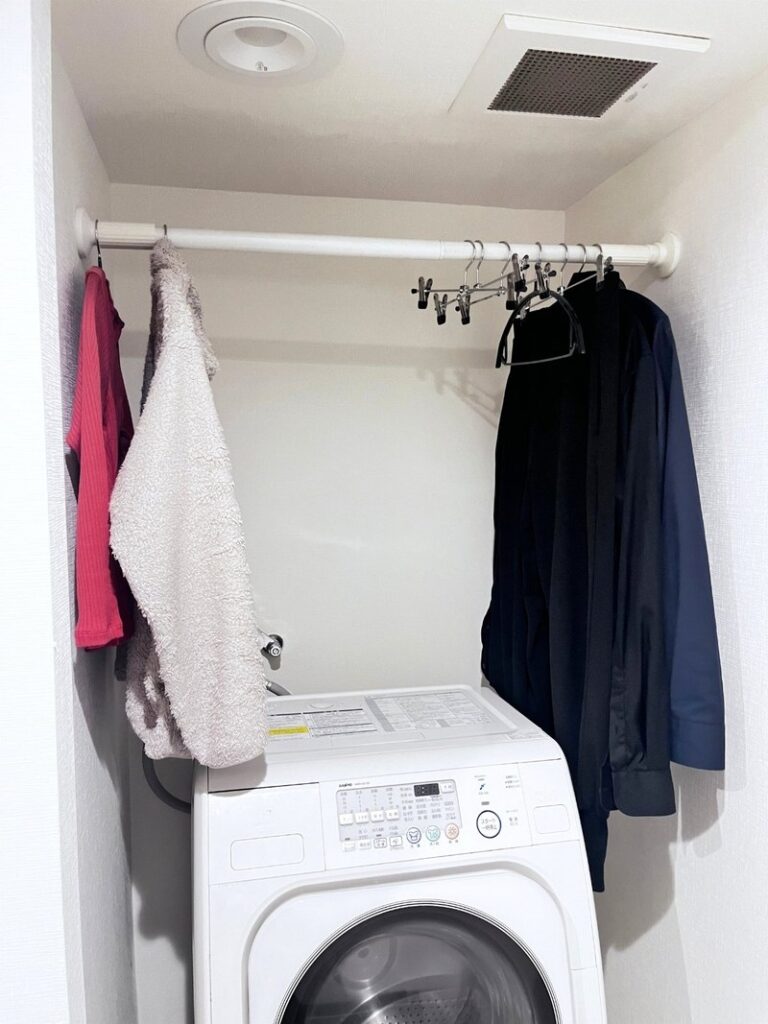
It’s not where things dry, but it’s where a lot of them start. When a load comes out of the washer, I clip things onto a pinch hanger right there on the rod, then carry the whole hanger out to the balcony or the bathing room. It’s fewer steps that way. It’s also a landing zone: a place to hang clothes once they’re already dry, so they don’t end up in a pile while everyone gets around to putting their own things away. It also doubles as the overflow spot for whatever gets displaced from the bathing room when someone wants a shower. Moving a load of wet laundry mid-dry isn’t fun — it’s heavier than you’d expect. But I’m genuinely happy with where I put the rod for exactly this reason: it’s close enough to the bathing room that the detour takes seconds, not a trip across the apartment.
Hangers by the Job
Most of what I dry stays on hangers straight through to the closet, rather than getting refolded once dry. That’s part of why I have dozens and dozens of the main hangers — clothes go from wet to dry to hung up in the closet without a hanger swap in between, so there’s no point keeping a smaller “drying” set separate from the closet set.
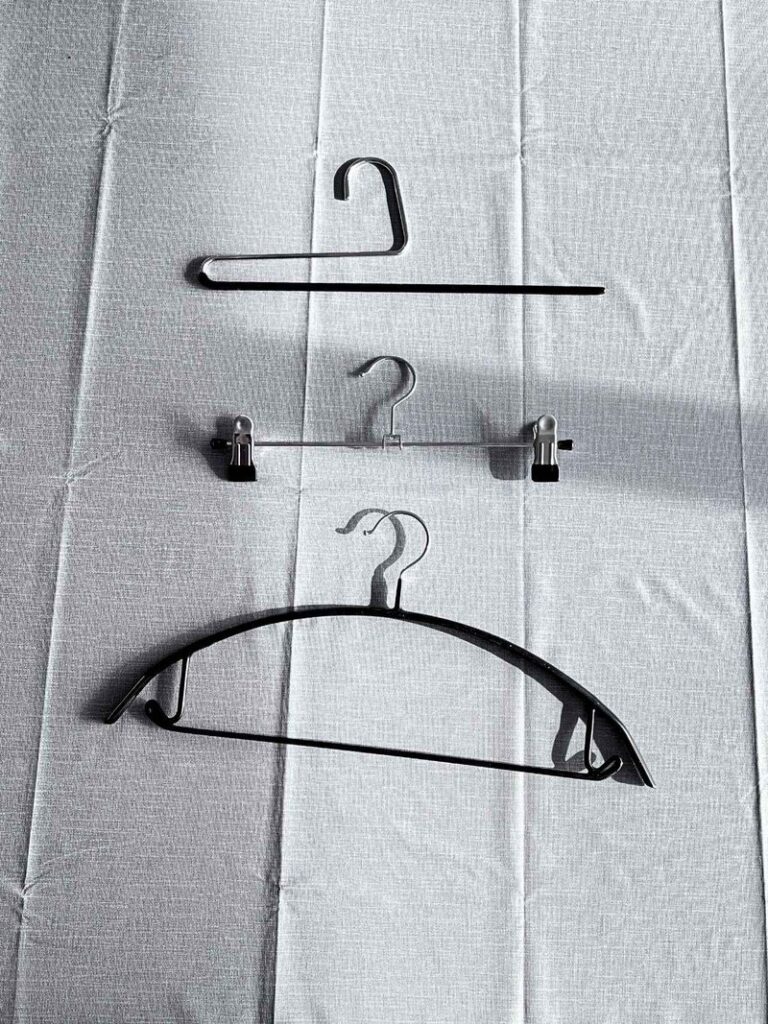
For shirts and tops, the hangers have a non-slip coating on the shoulders. Even dry, a T-shirt or a sleeveless top slides off a plain hanger more easily than you’d expect, which is why I switched. That coating alone doesn’t solve everything, though: a thin strap, like on a camisole, still slides straight off even with the non-slip coating. So the hangers also have small notches cut into the shoulders, just for hooking a strap in place.
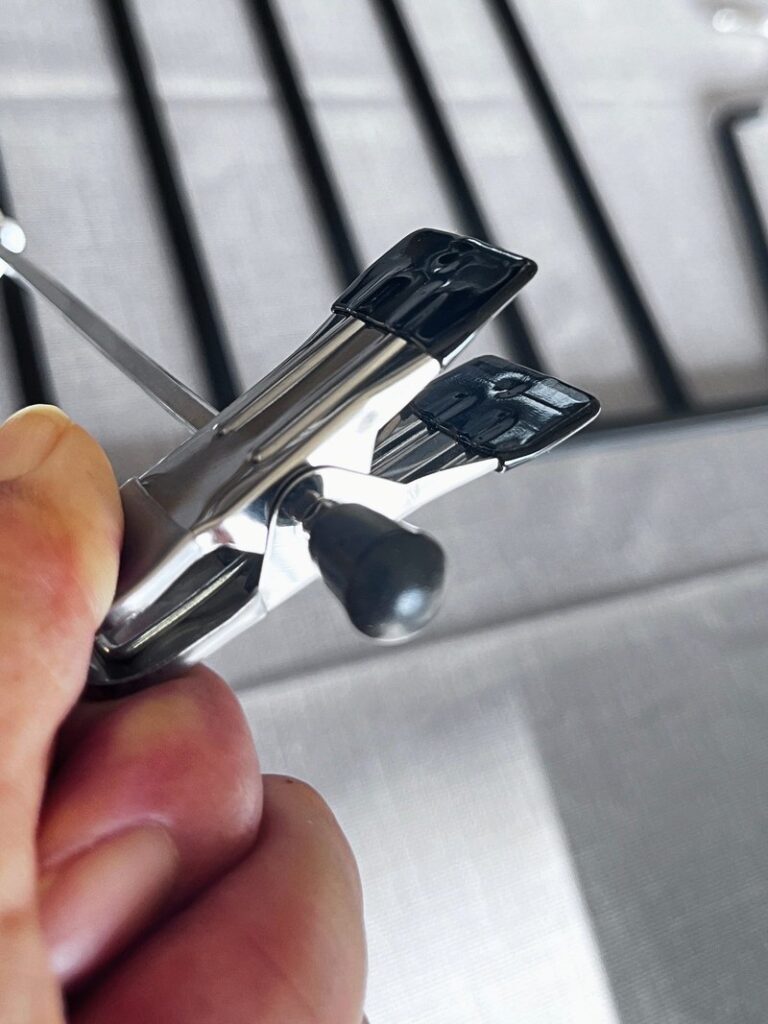
For pants and skirts, the clips slide side to side to fit different widths, and the inside surface of the clips is flat rather than ridged. Some versions of this style have a ridged, grippy texture on the inside of the clip instead — I’ve used both, and the ridged kind leaves a faint mark on fabric that’s been clamped there a while, so I look for the flat kind specifically.
For anything more delicate — things where even a flat clip might leave a mark — there’s a single bar hanger with no clips at all. It doesn’t get much use for drying; day to day, it holds slacks in the closet.
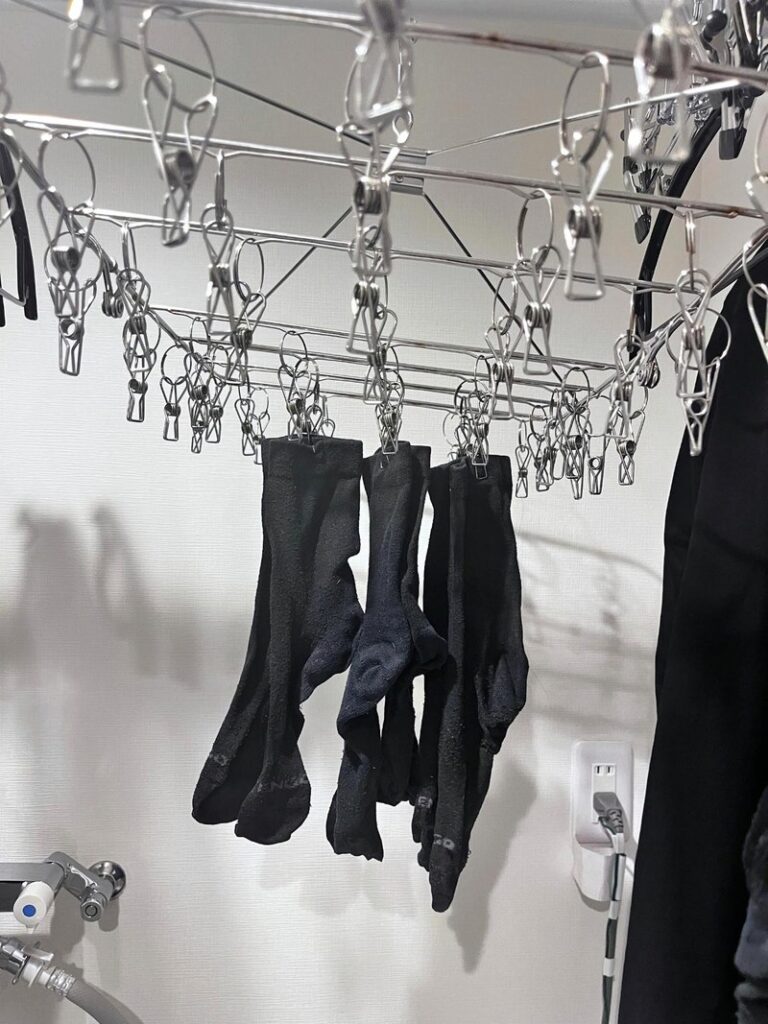
Small items like socks, underwear, and small towels go on a pinch hanger — a flat frame with a row of spring clips hanging underneath. I don’t know who made mine, but this shape is sold by a lot of different manufacturers in Japan, so it wasn’t a hunt to find one.
The hardest part of doing laundry is my husband’s socks. They’re all black, with slightly different lengths and designs, so they don’t sort themselves. When a full load comes in with several pairs of his mixed in, matching them up while clipping each one on becomes a small puzzle every time. It’s a happy kind of annoying, though — and on days I don’t have the patience for it, I skip flipping them right-side out or pairing them up and just clip them on as they are.
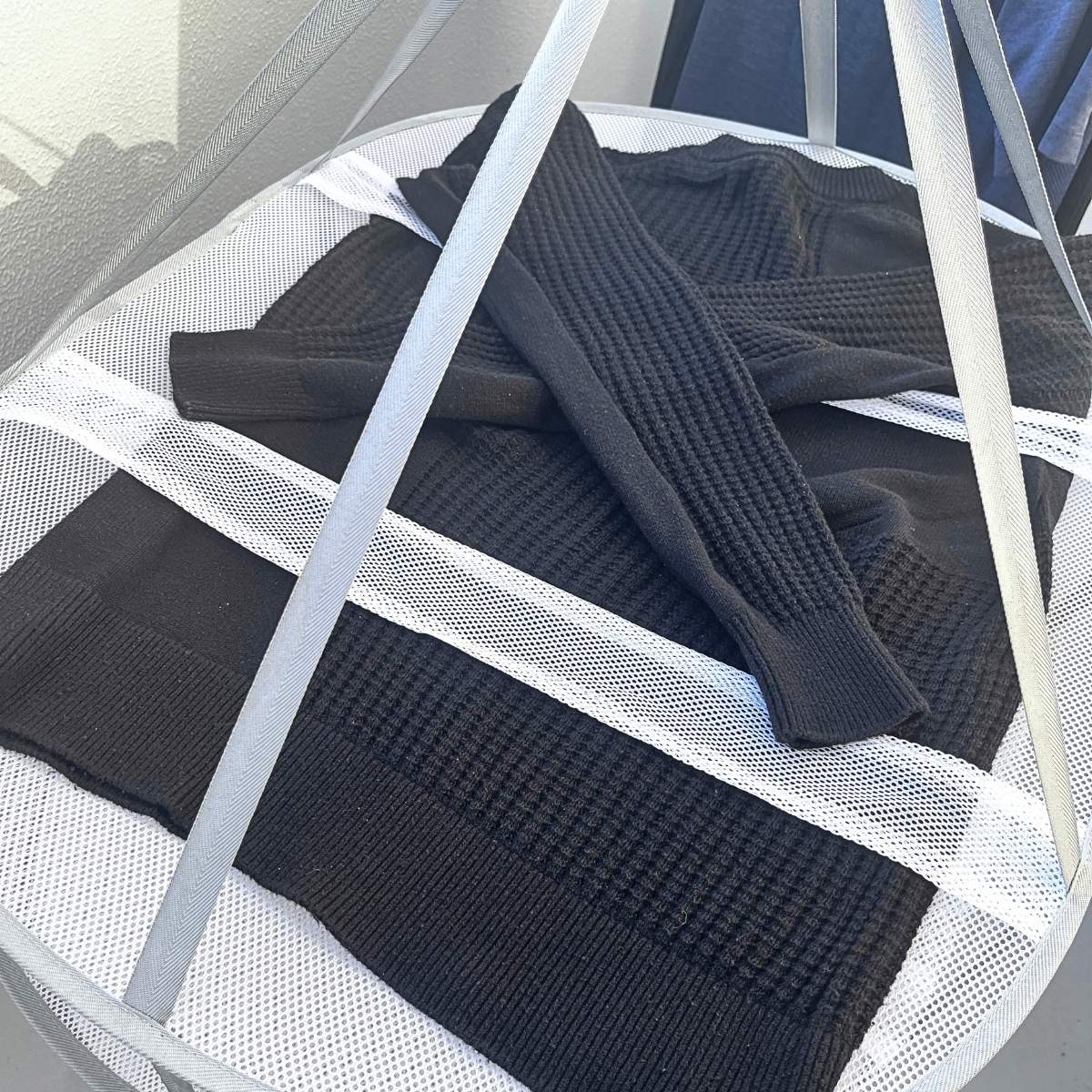
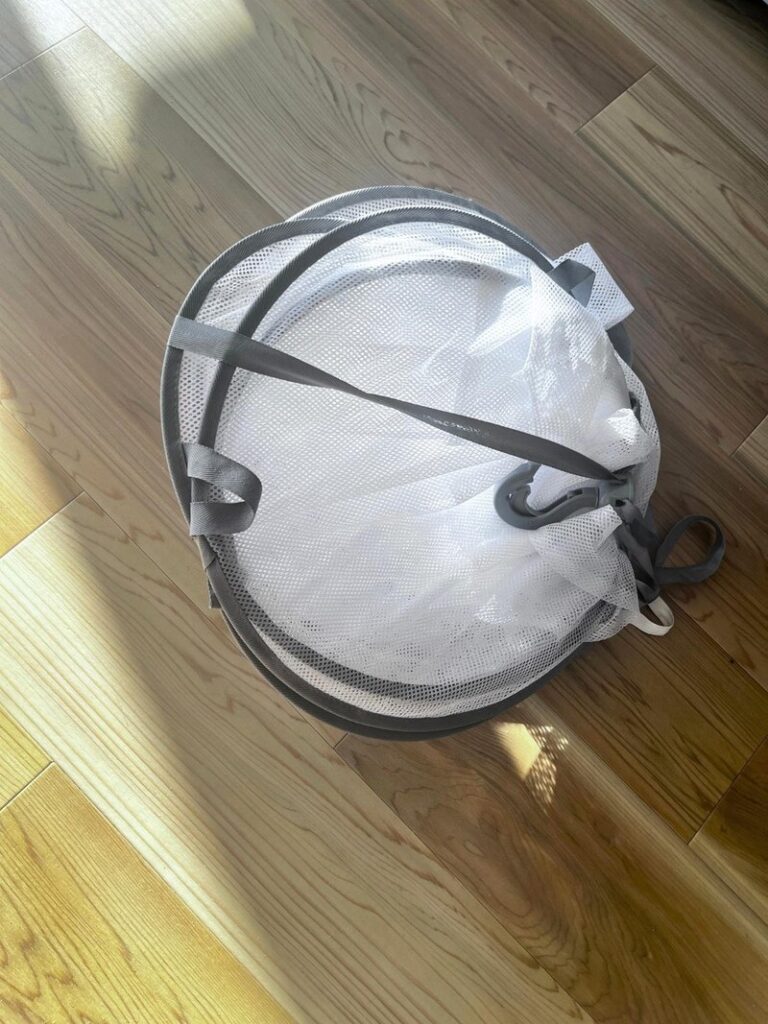
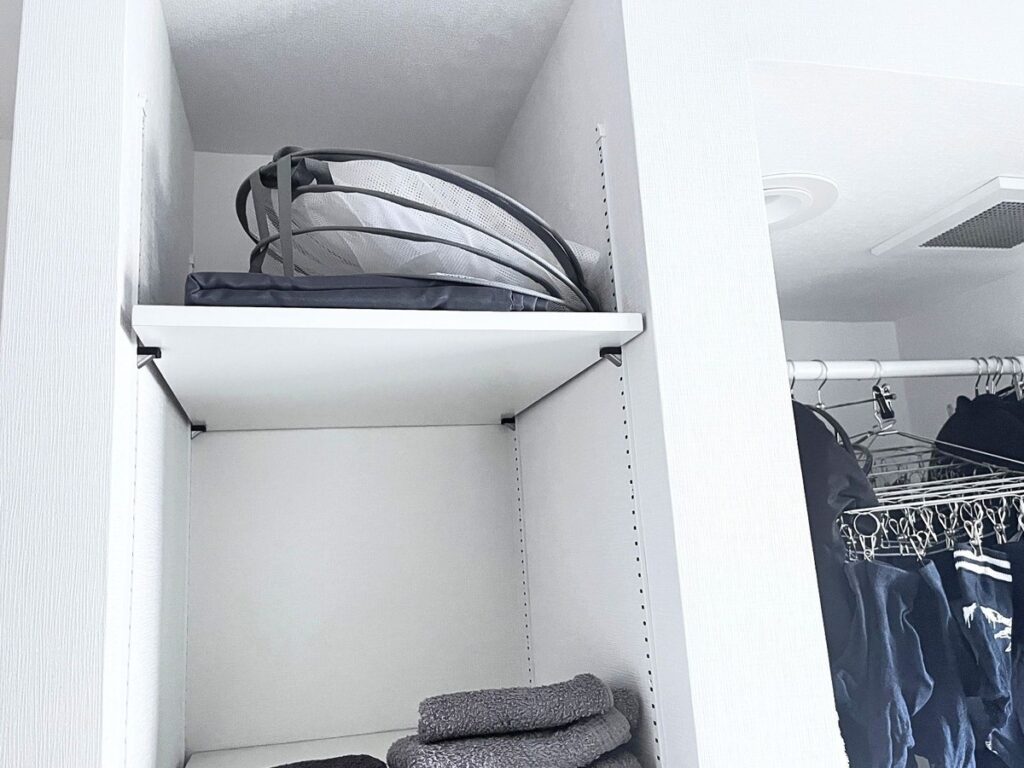
And knitwear that would stretch out of shape on a regular hanger goes on a 3-tier mesh rack from a brand called RemarksJapan, wide enough to lay even a large men’s sweater flat across each tier with room to spare, with a swivel hook at the top rather than a flat base, so it hangs from a rod instead of sitting on a surface.
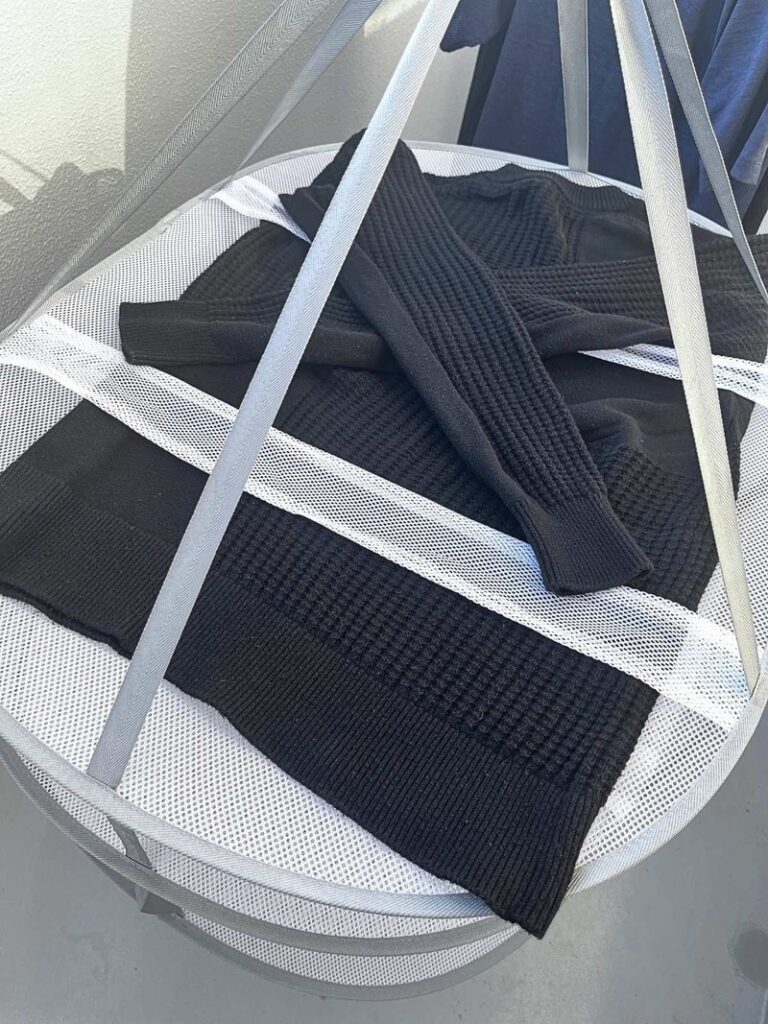
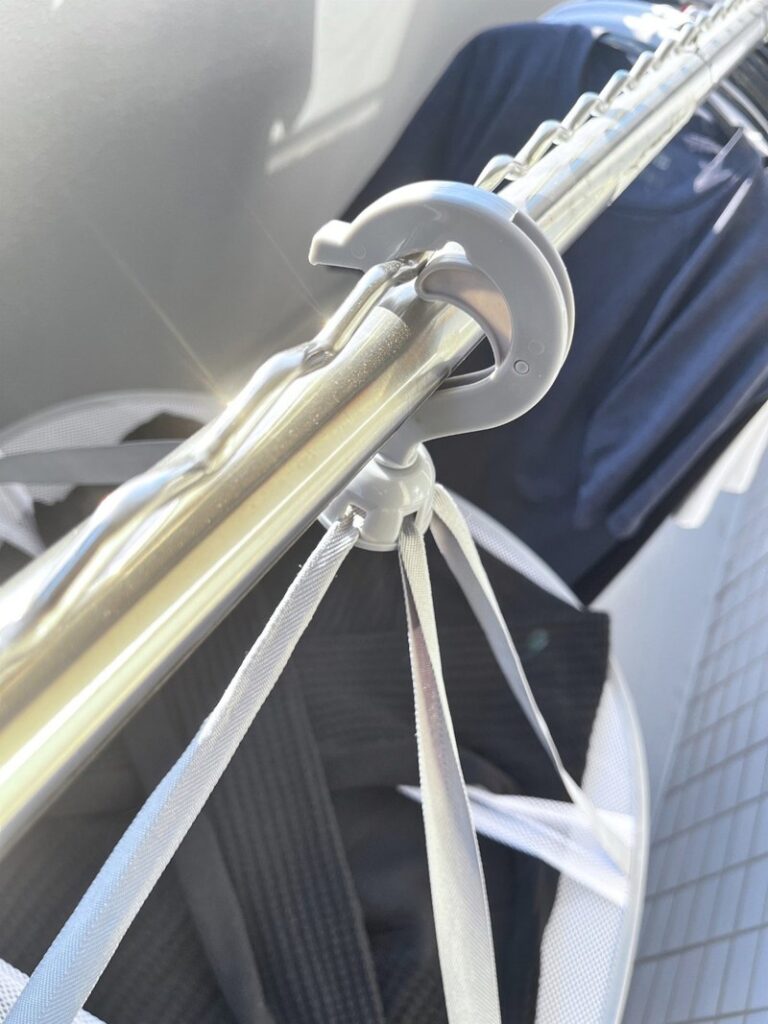
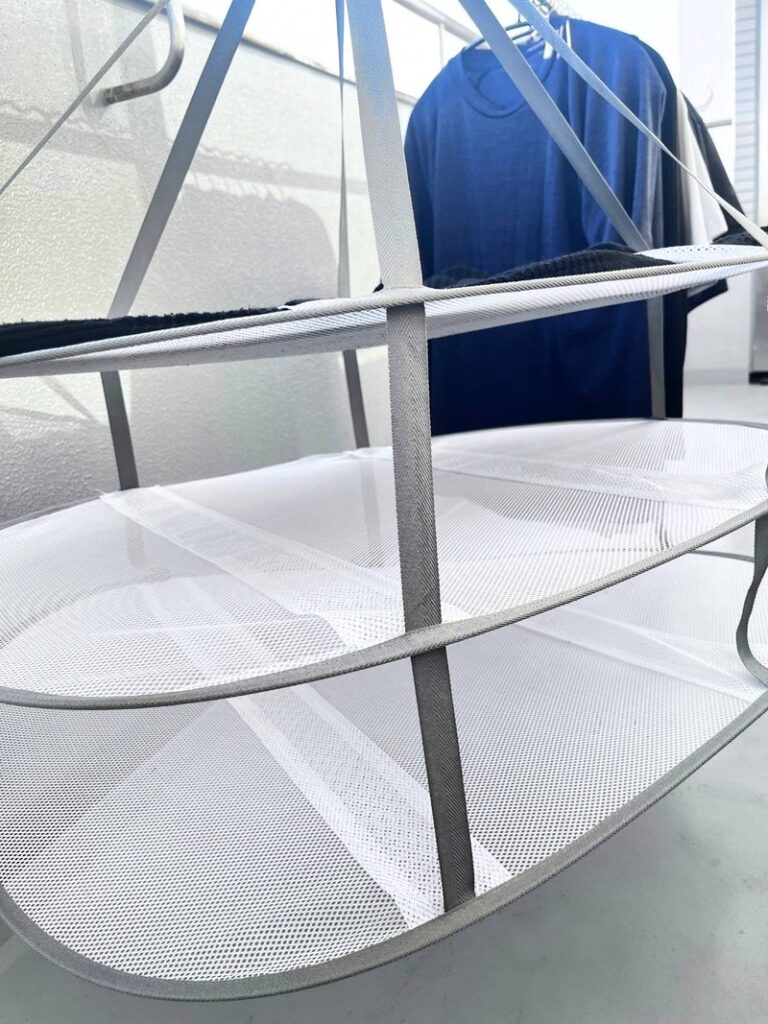
It gets the most use in winter, when there’s more knitwear in the rotation. There are standing versions of this kind of rack too, but I skipped those because I wanted something I could use on the balcony and in the bathing room. The listing says it folds down small, but at first it was sturdier and stiffer than I expected, and I couldn’t get the wire down as small as the packaging suggested. After a lot of use, though, it has loosened up, and it now folds down flat enough to store on a shelf. Nothing else gave me this much flat surface area for drying knitwear, so it’s become an even bigger favorite of mine.
What’s Available in the US
Several of these tools have close equivalents in the US:
- Pinch hangers for socks and small items — sold as “clip and drip hangers,” usually round rather than the rectangular shape common in Japan, but the same idea.
- Non-slip hangers with shoulder notches for tops — sold as “non-slip” hangers, with the camisole notches described the same way. Velvet ones are common too. I used them for a while, but the dust that got into the fuzz and the wear bothered me, so I moved away from them. How these hangers fit into the rest of my closet is in my closet piece.
- Adjustable clip hangers for pants and skirts — sold as skirt hangers with adjustable, non-slip clips.
- 3-tier mesh drying racks for sweaters — sold as “sweater drying racks,” including hanging versions with the same fold-flat, hook-mounted design as the Japanese ones.
Skroad Stainless Steel Drying Rack with 36 Clips
Amber Home 20 Pack Black Coated Metal Hangers
Ieoke Pants Hangers with Clips, 10 Pack
Looca 3-Tier Folded Mesh Hanging Sweater Drying Rack
The pole and the bath towel rack are the exceptions. I couldn’t find anything in the US with the same wavy-wire design for holding individual hangers in place, and I couldn’t find a flat, hook-on rack meant to hang bath towels from an outdoor pole either — the towel racks I found there were mostly wall- or door-mounted. Retractable clotheslines there tend to be either rope-based or a single reach-stick pole, rather than a rigid bar meant to hold a row of hangers.
If you’d like the bath towel rack itself, you can order it from Japan through Buyee or ZenMarket. My guide to ordering from Japan compares the two, so you can pick the one that fits your order. Both sites have a shipping calculator, so you can check the cost before you order.
Shimomura Kihan Bath Towel Rack (No. 26447)
Sizes at a Glance
- Nitori telescoping pole: 1.4–2.5m (4.5–8ft), rated for about 14kg (31lb); or 2.8–4.0m (9–13ft), rated for about 8kg (17.6lb)
- Shimomura Kihan bath towel rack: 72cm (28.5in) wide, 27.3cm (11in) deep, 16cm (6.5in) tall in use — folds to 5.5cm (2in); rated for about 5kg (11lb)
- RemarksJapan 3-tier mesh rack: 76 × 62 × 75cm (30 × 24.5 × 29.5in) when open
Where to find them
Skroad Stainless Steel Drying Rack with 36 Clips
Amber Home 20 Pack Black Coated Metal Hangers
Ieoke Pants Hangers with Clips, 10 Pack
Looca 3-Tier Folded Mesh Hanging Sweater Drying Rack
Shimomura Kihan Bath Towel Rack (No. 26447)
The Bottom Line
Whether or not a dryer is working in the house matters less than where you decide to dry things. Once that’s settled, the tools mostly sort themselves out by what each spot needs.