This post contains affiliate links (see my disclosure for details). As an Amazon Associate I earn from qualifying purchases.
People find Japanese storage products through photos — a narrow rolling cart that slides into a 10cm (4in) gap, a rack that hooks over the top of a door, a frame that stands inside a closet under the hanging clothes. They look clever, and they are. But they didn’t come from a design studio trying to be clever. They came from a set of constraints that most homes outside Japan don’t have.
That matters, because it’s the reason some of these products will change how your home works and others will arrive and sit in a drawer. This half is about closets and living spaces; the bathroom and kitchen get their own piece, since those rooms are built differently enough to need explaining on their own.
- The constraint underneath everything
- 1. Two kinds of closet, and the word that tells them apart
- 2. The real specialty: the dead air inside a closet
- 3. You are not allowed to put a hole in the wall
- 4. Storage lives high and low, not in the middle
- 5. The gap is a place
- What transfers and what doesn’t
- How My Own Closet Runs: Almost Nothing Gets Folded
- Where to start
- Where to find them
The constraint underneath everything
The average home in Japan is about 95 m² (1,023 sq ft). In the United States it’s about 214 m² (2,299 sq ft) — more than double. In Tokyo and other city centres, a one-room apartment for a single person — advertised here as a 1R or 1K — often comes in around 18–22 m² (about 195–235 sq ft).
That difference shapes a lot. Where there’s no spare room, no basement, no garage and no walk-in closet, storage tends to get worked into the space that already exists rather than added as furniture. Much of what follows comes out of that, and it’s worth reading less as an aesthetic and more as a response to a floor plan.
1. Two kinds of closet, and the word that tells them apart
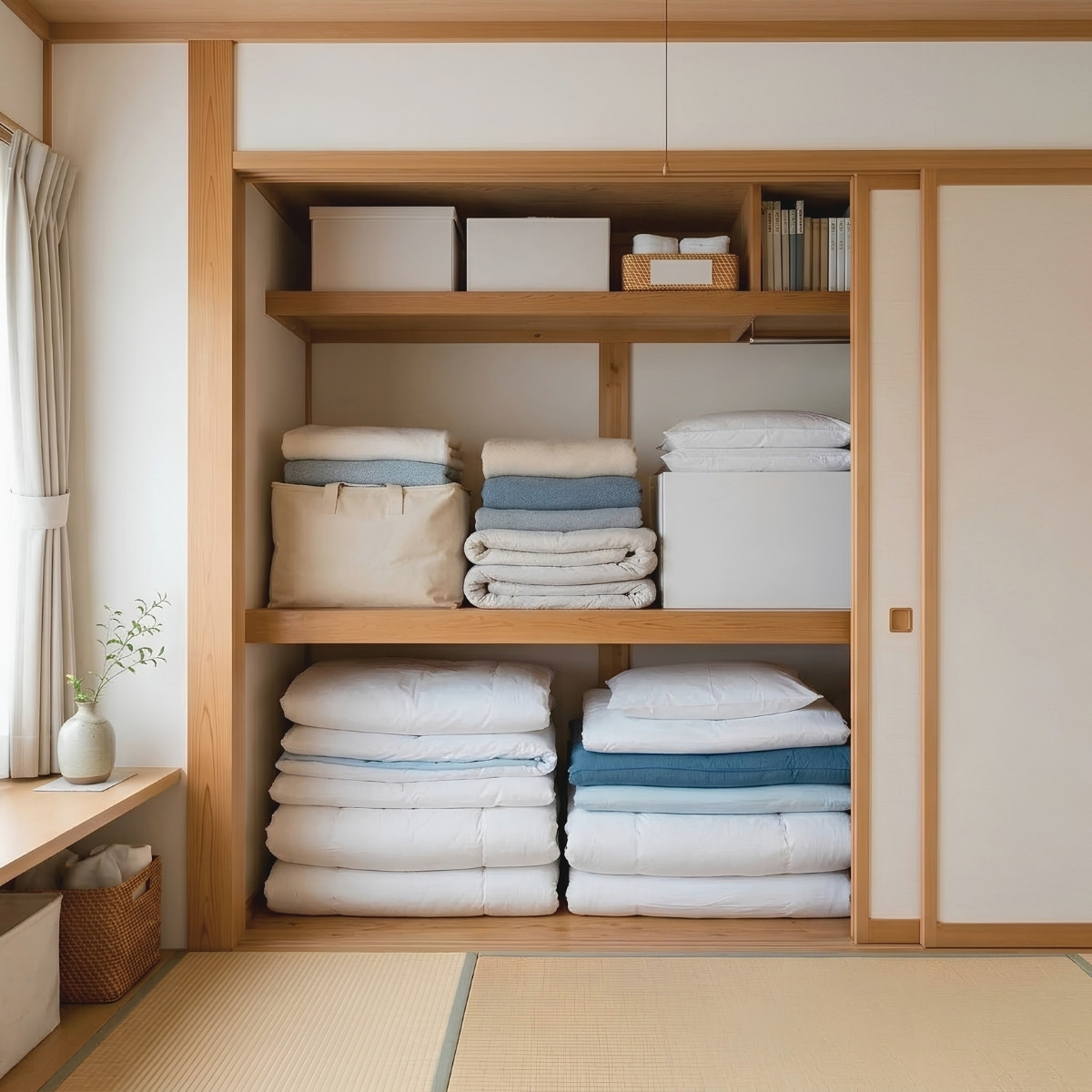
If you picture Japanese homes as tatami and futons, you’re picturing the older housing stock. Those homes have an oshiire — a deep closet with sliding doors, about 90cm (35.5in) front to back, divided into an upper and lower half by a shelf across the middle. It’s that deep because it was built to swallow folded futons.
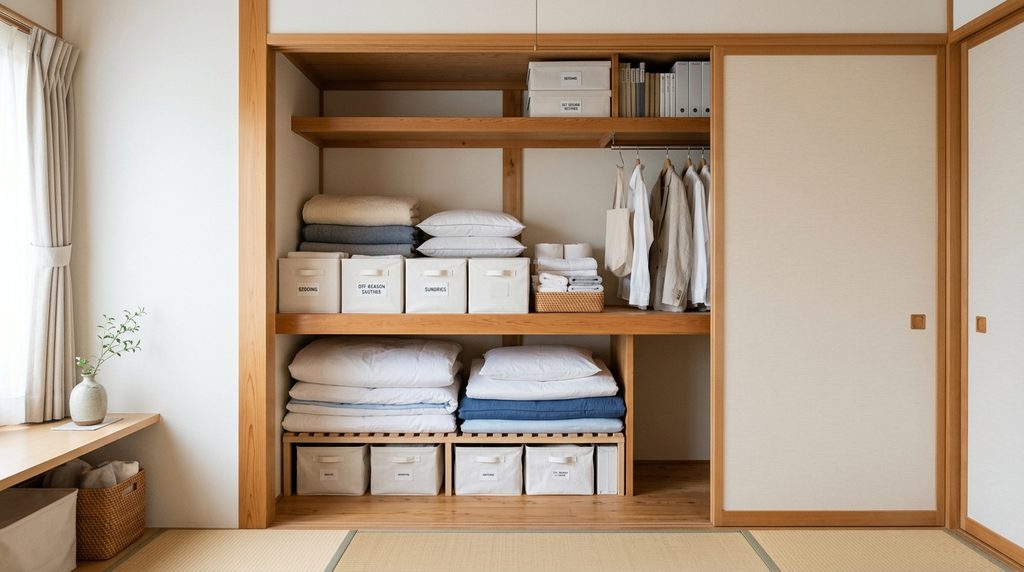
But most homes built in the last few decades have a Western-style closet instead, with a hanging rail, at a depth much closer to yours. It’s called a kurōzetto — the English word, borrowed.
Part of that comes down to how homes are used. Beds are common now, and a room planned around a bed doesn’t need a closet deep enough to hold bedding. Futons haven’t gone anywhere — they fold away, they free up the floor during the day, and plenty of people prefer them for exactly those reasons — but newer construction tends to be built with rail-and-shelf closets, and a good deal of the storage sold for them is sized to match. Either way, it’s worth checking which of the two a piece was made for rather than assuming.
I went and measured mine while writing this: 60cm (23.5in) deep. That is the same as a standard Western reach-in closet. Which is the whole point — a Japanese closet organizer built for a modern Japanese home is built for roughly the space you already have, and the exotic 90cm (35.5in) figure only applies to the other kind of closet entirely.
The two take completely different products, so it’s worth knowing which one a piece was made for. Some listings say it outright, and if you see either of these in the product name or category, it settles the question:
- 押入れ用 (oshiire-yō) — made for the deep traditional closet. Assumes about 90cm (35.5in) of depth. In a 60cm (23.5in) closet — Western or modern Japanese — this will stick out past the door by a foot.
- クローゼット用 (kurōzetto-yō) — made for a rail-and-shelf closet like yours. This is the one you want.
But don’t count on finding those words. Plenty of storage products carry neither label, and in practice most people shop by size rather than by label. What Japanese listings tend to be good about is dimensions: width, depth and height in centimetres, and load ratings in kilograms. That’s usually what the decision turns on. Measure your space, read the numbers, compare. The vocabulary is a useful shortcut when it happens to be there; the tape measure is the method.
2. The real specialty: the dead air inside a closet
This is the part that gets overlooked, because it doesn’t photograph as exotically as a futon closet. It’s also the part most likely to be useful to you.
A closet with a hanging rail leaves a lot of space unused. There’s a void under the short garments, a strip of unused height above the rail, a dead column at either end, and usually a shelf overhead that’s awkward to reach. When floor plans are tight, that air is worth reclaiming, and a lot of what gets made here is built to do exactly that:
- Frames and shelf units built to stand under hanging clothes, at the exact heights that clear a shirt or a coat
- Tension rods used to add a second, lower rail so the void becomes a hanging space too
- Fabric hanging shelves that clip onto the rail and turn vertical air into five compartments
- Slim drawer towers sized for the leftover column at the side of the rail
- Boxes and trays designed for the too-high overhead shelf, with a strap on the front so you can pull them down without a stool
Look at this category first. The problem it solves is universal — every closet in every country has this dead air — and because these products are made for rail-and-shelf closets, they’re designed for dimensions close to yours rather than for something you don’t own.
3. You are not allowed to put a hole in the wall
Japanese rental contracts carry an obligation to restore the property to its original condition when you leave. In practice that means no drilling, no anchors, and often not even large adhesive hooks. Deposits are withheld over nail holes.
An entire product category grew out of this. Tension rods — tsuppari-bō — are sold here in dozens of lengths and load ratings, and they are the backbone of Japanese storage: a rod wedged between two surfaces becomes a hanging rail, a shelf support, a pantry divider, a second tier inside a closet. Alongside them sits everything else that attaches without damage: over-the-door racks, freestanding towers wedged floor-to-ceiling, units that hook over a counter edge or the side of an appliance.
If you own your home and can drill freely, some of this ingenuity is solving a problem you don’t have. A ¥3,000 (about US$19) tension rod is not better than a US$6 wall anchor — it’s what you use when the anchor isn’t allowed.
The pieces still worth importing are the ones where the no-damage design produces something better rather than merely permissible: things that hang on doors, hook onto shelf edges, or stand in gaps. The bathroom and kitchen piece has photographs of a tension rod doing real work in my own flat, if you want to see the mechanism.
4. Storage lives high and low, not in the middle
Japanese homes are still organized around floor level. Shoes come off at the genkan, the sunken entry, which is why shoe cabinets are a serious furniture category here rather than an afterthought. Living happens closer to the ground.
The consequence is that the middle band of the wall — roughly waist to shoulder height, where Western homes put dressers and sideboards — stays clear, and storage is pushed above head height or under things. Over-the-door racks, above-the-fridge shelving, under-sink towers, under-bed drawers. This idea transfers most cleanly of all, because it costs nothing and depends on no measurement: look up and look under before you buy another cabinet.
5. The gap is a place
Storage furniture is usually sized to fill a wall. A lot of Japanese storage furniture is instead sized to fill a sukima — a gap. There are rolling carts made specifically in 12.5cm (5in), 15cm (6in), 17cm (6.5in) and 20cm (8in) widths, because that is the space between a refrigerator and a wall, or between a washing machine and a cabinet.
If you’ve had room to spare, there’s never been much reason to measure those spaces. Once you start, you find them everywhere — and this is where an imported piece can earn its shipping cost, because these sizes are rarely made where floor space is less of a constraint.
What transfers and what doesn’t
Being honest about this is more useful than selling you on all of it:
- Transfers well. Closet-interior organizers sized for a rail-and-shelf closet — under-hanging frames, rail-mounted hanging shelves, slim side towers, overhead-shelf boxes. Gap-width carts. Over-the-door and over-the-cabinet racks. Under-sink and under-bed systems. And the habit of measuring gaps rather than walls.
- Transfers if you check first. Tension rods — they need two parallel surfaces at the right span, and load ratings are given in kilograms.
- Usually doesn’t transfer. Anything marked 押入れ用, at roughly 90cm (35.5in) deep. Futon storage bags, unless you sleep on a futon. Shoe cabinets built around a genkan step. Anything solving the no-drilling problem when you’re allowed to drill.
- Never assume. Dimensions come in centimetres and load ratings in kilograms. Convert them and check against a tape measure in your own home first. Shipping furniture across the Pacific and finding it’s 10cm (4in) too deep is an expensive way to learn this.
How My Own Closet Runs: Almost Nothing Gets Folded
Our laundry dries on hangers — out on the balcony on sunny days, in the bathing room when it rains — and those same hangers go straight into the closet. I don’t switch hangers between drying and storing, so most of our clothes never get folded at all. I wrote about the drying side here: How We Dry Laundry Indoors in Japan.
That only works because the hangers match the job. Tops go on non-slip coated metal hangers with small notches on the shoulders, so thin camisole straps stay put. Mine have been in use for about six years, including out on the balcony, and the coating hasn’t turned sticky. I skip velvet hangers: I’ve used them, and dust caught in the pile doesn’t come out, and the pile itself wears down over time. In the US, Amber Home’s black coated metal hangers are a similar type, with notches and a matte finish.
Amber Home 20 Pack Black Coated Metal Hangers
Most bottoms go on clip hangers whose clips are smooth on the inside, not ridged — ridged clips can leave marks if they stay on for a while. For the pieces I’d rather not clip at all, I use open-ended hangers and simply drape them over the bar. Clip hangers like Ieoke’s and open-ended ones like Zober’s are easy to find in the US; just check that the clip pads look smooth.
Ieoke Pants Hangers with Clips, 10 Pack
Zober Open Ended Pants Hangers, 20 Pack
Underwear and socks go into a double-sided hanging organizer with pockets. I just tuck them in, no folding. Simple Houseware’s 24-pocket double-sided organizer is a US version of the same idea. Bras are the one thing I haven’t solved yet: my current multi-tier hanger tangles the straps, so I’m still looking.
Simple Houseware 24-Pocket Double-Sided Hanging Closet Organizer
Winter scarves hang on a five-tier hanger, because folded ones slump the moment I pull one out. Mine is open on one side; the five-tier hangers that sell well in the US, like this one from Mooyuuu, have arms that swing out instead. Either way, you can take one off without moving the rest.
Mooyuuu 5-Tier Pants Hangers, 3 Pack
Next to them, a fabric shelf unit hangs from the rail. It holds knits I’d rather not hang, the scarves I reach for most, and anything that doesn’t have a place yet. Shelves like this come in different heights and numbers of tiers, so measure the space under your hanging clothes first. In the US, YOUDENOVA’s six-shelf unit is a popular one.
YOUDENOVA Hanging Closet Organizer, 6-Shelf
Where to start
Don’t start with furniture. Open your closet, and measure the three spaces you currently treat as unusable: the height of the void under your hanging clothes, the width of the dead column beside the rail, and the depth of the shelf above it. Write the numbers down. Then go looking for what exists in those exact dimensions. 収納 (shūnō) is the word for storage, and adding クローゼット narrows it usefully — but read the centimetres, not the labels.
That habit — measuring the leftover space rather than the room — is a fair bit of what’s going on here.
The other half of this, on bathrooms and kitchens, is here: Japanese Bathroom and Kitchen Storage. And some of these products can only be bought in Japan, so for those you’ll need a proxy service — I wrote a walkthrough of how that works and what it costs: How to Order From Japan.
Where to find them
Simple Houseware 24-Pocket Double-Sided Hanging Closet Organizer
YOUDENOVA Hanging Closet Organizer, 6-Shelf
Amber Home 20 Pack Black Coated Metal Hangers
Zober Open Ended Pants Hangers, 20 Pack
Ieoke Pants Hangers with Clips, 10 Pack
Mooyuuu 5-Tier Pants Hangers, 3 Pack